Strolling Amok

Pops goes on tour.

Archive for the category “Campsites”

World of Speed 2014

The call of Bonneville.

The call of Bonneville.

The World of Speed event at Bonneville is run each year by the Utah Salt Flats Racing Association, and participants were able to run what looked like their choice of 3 or 5-mile courses laid out on the salt. That’s much shorter than they would like, but current weather conditions dictate how much of the track will be dry enough to run on. Most of the vehicles don’t need any more distance, so only the big boys had a crimp put in their style.

Yes, this mini-belly tank racer is just a toy, and yes, it's cute! Racers of all kinds tend to have a sense of humor.

Yes, this mini-belly tank racer is just a toy, and yes, it’s cute! Racers of all kinds tend to have a sense of humor.

I attended one day when the weather looked most cooperative, though I did have to wade the big Ford s-l-o-w-l-y through nearly a mile of brine to get there. I ferried the Evelo Aurora and trailer across in the front bike carrier, and then broke it out to tour all around the dry pits and racing area. Considering my phobia about splashing salt on the underside of the pickup truck, the decision to attend was no small one. Looking at upcoming weather, I had a gut feeling that this one day might possibly be it for the season, so it was either go, or gamble. The depth of the water between Read more…

Are We Marooned Yet?

In general, the water running down vast slopes collected and concentrated in flow so that few side trails were left untouched. This shot is taken at a point up Leppy Pass' long upward climb, and was possible for me only because of the bike's electric motor to help me get up there.

In general, the water running down vast slopes collected and concentrated in flow so that few side trails were left untouched. This shot is taken at a point up Leppy Pass’ long upward climb, and was possible for me only because of the bike’s electric motor to help me get up there.

I took the Aurora e-bike out on a trash run this morning to have a look around the area, looking at the end effects when weather has its way with desert that has miserably sparse ground cover.

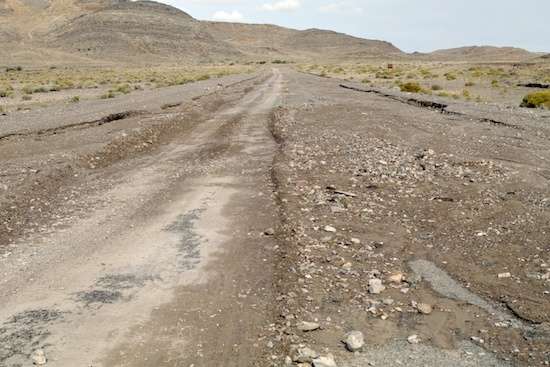
I'm standing on Leppy Pass Road looking uphill. It's a nice paved two-lane, and I suppose still is, under all the mud and rocks that charged down along it and across it during the rainstorm.

I’m standing on Leppy Pass Road looking uphill. It’s a nice paved two-lane, and I suppose still is, under all the mud and rocks that charged down along it and across it during the rainstorm.

It turns out that the recent rainstorms were about as destructive as they were last year, but Leppy Road’s shoulders were in better shape to start with, and suffered less spectacularly as a result. If you’ve suffered through this blog for long, you’ll recall that last year, a deep new gully did its best to swallow a road grader. There is now one section carved down about four feet deep, but it’s quite short. My trail branches to intersect Leppy Road at two points, and both junctions are damaged enough that a mindless exit would, at best, firmly ground out the low-slung Defiant. At worst, the Read more…

Learning Comparative Weather

Looking out the port-side living room window while the solar panels are battened down.

Looking out the port-side living room window while the solar panels are battened down.

When we live in houses (assuming that they are sturdily-built houses), we tend to consider weather as something that happens “out there”. I’m still in the process of learning the fact that I’m closer to living “out there” than I used to be. At this camping location near the Bonneville Salt Flats east of Wendover, Utah, weather is quite an issue at times. The paved road I’m near, Leppy Pass Road, had its shoulders severely washed out last year. That’s because this whole area is basically one vast surrounding slope from several low mountain peaks down to the flats. Here, a tenth of an inch of rain is significant, and any gathering runs of rainwater become interesting.

Rains a week ago wiped out any chance of late September or October land speed record attempts. I did manage to attend one such event before that, and will post it soon. But heavy rains became redundant the evening before last, as a cool front moved in. Cool fronts bring high winds here, and they often start banging around in

Read more…

The Cheapskate’s Dilemma

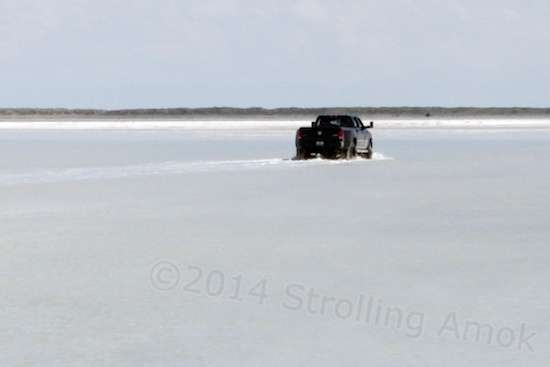
A pickup truck wades out toward the dry part of the salt flats used as the race course.

A pickup truck wades out toward the dry part of the salt flats used as the race course.

Something I hadn’t banked on from last year’s all-or-nothing weather at the Bonneville Speedway was that part of the salt flats could be dry and usable for speed events, while the rest could be terminally underwater. It’s a fairly common situation, as it turns out. The endpoint of the access road to get there is nicknamed the “boat ramp” for just that reason. Right now, it’s under what I’m guessing is 9″-12″ of water, depending on the path you take. It was much shallower on Friday morning before a passing thunderstorm dumped more water on it. The track area apparently survived, while the entrance did not.

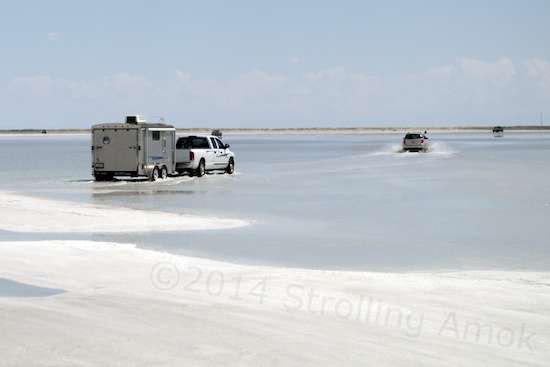
The two techniques used: on the left is the wader, rolling slowly through so as to limit splashing of the saltwater. On the right is the impatient hard charger, who must have a rental or leased car, because no one would do this to a personally-owned vehicle, would they?

The two techniques used: on the left is the wader, rolling slowly through so as to limit splashing of the saltwater. On the right is the impatient hard charger, who must have a rental or leased car, because no one would do this to a personally-owned vehicle, would they?

Beginning this weekend and running through Thursday, the Bonneville Motorcycle Speed Trials are taking place. The water entrance hasn’t proven a problem at all for the racers and hangers-on. They just dive right on in with whatever they have.

I find this impressive, but less so after I think about it. These guys make

Read more…

Damage Control! Report!

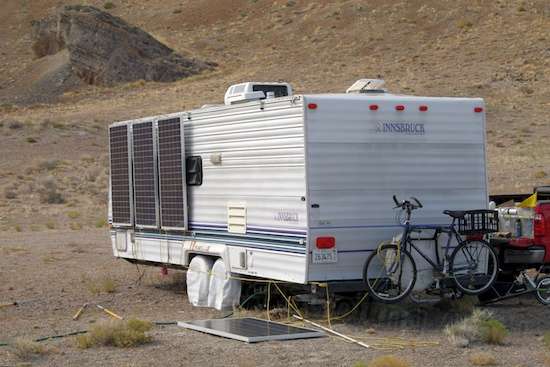
Solar panel #4 safely on the ground after being found hanging on one hook.

Solar panel #4 safely on the ground after being found hanging on one hook.

RVs are heavy – ask anyone at a fuel stop. But they also have a very large sail area, a trait which rarely works in their favor. They are highly subject to bad weather and, out west, there’s plenty of that to go around in the late summer.

A couple of nights ago, a very high wind came up in camp, one that wasn’t in any forecast. The forecasts said current wind was and would remain at 6 MPH. Night winds haven’t been unusual here in Wendover, blowing in well after sunset and rotating around in all directions for an hour or so. Often, it’s like throwing a switch on a fan.

Well, this one was a doozy. The good news was that it decided to blow in pretty much straight from the nose of the trailer, which poses the least threat to the Kleenex box aerodynamics of the Defiant. Wheel locks between each pair of trailer tires work quite well to resist any movement.

The wind had started in as usual, but didn’t let up this time, and I stayed up just short of midnight just to Read more…

How Goes the Battle?

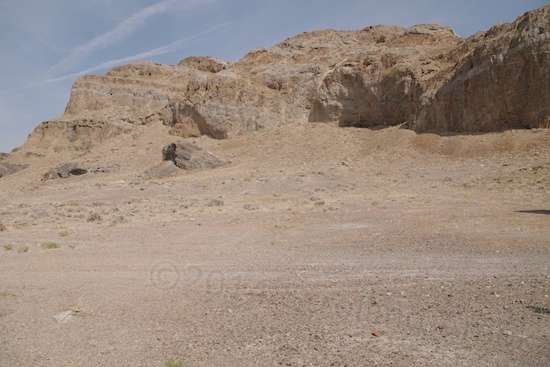
The lowest edge of the Silver Island Mountains, where I'm camped.

The lowest edge of the Silver Island Mountains, where I’m camped.

Camping at the foot of the Silver Island Mountains in August has been interesting so far. The heat each day has been predicted to be around 90, which is well above my comfort zone. Actually, the predicted highs are pure air temperatures, and may be correct. But as is common in desert areas, you’re actually camping in radiated heat as well, which comes off of vehicles as well as the ground. That bumps shaded thermometer temperatures up another 5 degrees at least, a perceptible difference when you stand in an open doorway or in front of a window. It’s predicted to hit 93 today and 94 tomorrow before dropping into the high 80s. That means I’ll be enjoying close to 100 degree heat until the break. Needless to say, I’m taking it easy for now!

The camper’s old Dometic refrigerator is not particularly happy about it, either. Even running at full throttle on propane, temps in the lower section have been edging up to 50 during the daytime, prompting me to clear its propane burner and stow purchased ice inside it in an attempt to help it out. It does help, but not as much as I’d hoped. I’d like to mount a tarp or other sunscreen in front of the unit’s exterior wall, but a good way to mount it without blowing away or stressing the solar panel hardware is not popping up, and the sole hardware store here in Wendover is not outfitted well at all, and that’s putting it politely.

The Vermin Battle has had mixed results. Last year, at a location about a quarter mile away, the camper was eventually overrun with mice, and the flies were incredible. I actually had multiple fly strips hanging from the ceiling then. This year, the fly count is minimal, and I’ve had no mouse intrusions. The new Tri-Level Vermin Defensive System (TVDS) appears to be holding so far. That system consists of two or three ultrasonic repellers inside, as well as baited snap traps in key locations. Outside, a Victor Tin Cat mass trap acts as a lure away from the trailer. It has caught two mice so far, apparently intercepting them before they could get to the trailer.

What I hadn’t expected were chipmunks. Active, cheery little creatures that scamper about in amazing quantity here. Larger than mice and more agile, the openings in the Tin Cat pose no threat to them. None have tried to come into the camper, so they have been of no concern – until I heard one methodically tearing the felt-like lining out of the trailer’s white tire covers. Then I noticed one disappear up into the front end of the Ford. Uh-oh. Opening the hood revealed a nest the size of a hat on top of one of the two batteries, and an annoyed chipmunk peering out of a fenderwell opening to see who the big dumb intruder was. The nest was made entirely from dark insulation, which prompted me to wonder what this insulation had been stripped out of. It wasn’t from the tire covers. It wasn’t the camper’s fiberglass. My guess was that they were stripping the Ford out.

How long before they started idly chewing through wiring insulation, potentially disabling it? I’d once returned from a week-long vacation to find that my ’58 GMC pickup wouldn’t start, the result of a woodchuck eating away all the insulation around the ignition wires. Never again, I had grimly determined, never again. Now, here was the Ford, a virtual electronic minefield.

As Bugs Bunny liked to say before his cartoons were deemed too violent for children and taken off the air, “Of course you realize, this means war!” I went back into the trailer to figure out how to best protect the Ford. In the meantime, the chipmunks joyfully frolicked outside, and one even took to seeing how far he could climb up the screen door. Three times. Whenever I would go outside they would scamper away and leave me in peace for a half-hour. Then they’d return as boldly as before.

I decided as a result that two approaches would be required to defend the Defiant’s Power Module from further attack. First, one ultrasonic speaker would be deployed under the hood, powered by the Ford’s batteries via a 50-watt inverter that I have. A 7.5-watt solar panel I have was added to keep the constant power drain from affecting them. Should that fail, a baited snap trap was placed on each battery. That was Phase One.

I reluctantly determined that a Phase Two would be necessary as well. I was often seeing 4 or 5 chipmunks at a time, and that was just around the Ford only. I had to aggressively scale down their sense of ownership of my campsite, and end their perception that the area was fair game. They needed to perceive a threat. I managed to set aside my mental legacy of the Disney Syndrome, where all small creatures talk to each other in their matching little hats and vests, and break out my ancient Crosman Model 130 air-pump .22 pistol.

It was a pitched battle from the start as I confined my shots toward the front end of the Mighty Furd, some 30 feet away from the trailer door. If it’s any consolation, I missed far, far more than I hit. The end result at this point has been no apparent further intrusion into the Ford’s engine bay, and only occasional area visits by one chipmunk at a time. The party is apparently over, the danger has been perceived, and target practice is at most once a day now. The scattering gravel at least lets them know that the area is still risky to be in. Lest you think this is an inordinately cruel solution, note that I also unhappily discovered that these chipmunks are eagerly cannibalistic, and the small, limping badger in the area carries away what’s left when I’m away from camp. Not the happiest post I’ve ever written, but it’s real. Now and then, in between the magnificent vistas and the interesting people, you get this. A sweaty, death-dealing desperado!

Bonneville’s Jinx?

The new Rancho Begley. Note that the Aurora, loaded with dirty laundry, looks more at home out here than it does in a suburban area.

The new Rancho Begley. Note that the Aurora e-bike, loaded with dirty laundry, looks more at home out here than it does in a suburban area.

With the Southern California Timing Association’s Speed Week event scheduled to run August 9-15 this year, recent sprinkles had bumped the planned start by just a day, with first actual runs to start on Monday instead of Sunday. Not bad. When I arrived Friday afternoon, everything was looking promising. The short drive from I-80 to the “Y” intersection of the access road to the salt and Leppy Pass Road to the camping areas at the foot of the Silver Island Mountains was jammed with traffic and vehicles parked on the shoulder. Several BLM Rangers were directing the stream of traffic, asking each driver what they hoped to do, and then directing them as needed.

This guy is hoping to run his Cummins diesel-powered rod for a record.

This guy is hoping to run his Cummins diesel-powered rod for a record.

I made my way up toward last year’s campsite, found a workable area, and parked just long enough to yank the Evelo Aurora off the front end of the Ford. Racers are nothing if not celebratory partygoers, and although I found a Read more…

Horsies!

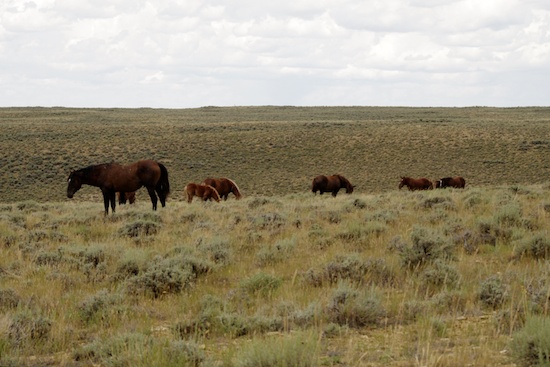
This group of horses was just yards from the roadway.

This group of horses was just yards from the roadway.

My bike ride today netted me a lot of shots of some of the horses that are often found along Wild Horse Canyon Road in Green River, Wyoming. Since I don’t know when I’ll be posting next, I thought I’d simply throw up some of the snaps for those of you who especially like horses. None are great, but they do show Read more…

Wild Horse Canyon Road

The long climb up from Green River, Wyoming tends to get one's heart and spirit a'thumping.

The long climb up from Green River, Wyoming tends to get one’s heart and spirit a’thumping.

I had partially forgotten the sensation of driving up Wild Horse Canyon Road’s 1,300′ climb above Green River, Wyoming’s 6,100′ elevation. That’s enough to drop temperatures several degrees, and enough to make life very comfortable for heat-generating persons such as myself. The main climb is gravel over dirt, and four thoughts kept churning in my mind during the ascent. The first was that Wild Horse Canyon Road is almost exhilarating to drive up, since the views presented during the unrelenting climb are impressive. The second thought was of course wondering if I’d once again see any wild horses. Were the two I saw last year a fluke? Third, the road itself prompts a mental note to take the descent seriously when I leave. The Ford’s brake module failure has decreased the amount of braking that the trailer alone can contribute. That alone is unlikely to pose a problem, but a wet descent could. Fourth, the slow climb, rough in many places, was such a crawl as to prevent locking up the torque converter. “I hope it’s okay with this long a period of stress”, I thought to myself. The trans temp itself stayed unmoved from normal. You don’t need to know anything about torque converters to appreciate this concern, because all you need to know is that they are expensive to be replaced. Near the top, it occurred to me to put ‘er in 4WD Low, to ease the strain, and that worked out great. Fortunately, the first two thoughts dominated the others, and near the top of the initial climb, I was rewarded with the distant sight of a small herd of horses grazing upon a hilltop.

I guess they don't call it Wild Horse Canyon Road for nothin'!

I guess they don’t call it Wild Horse Canyon Road for nothin’!

Once again, I'm caught with my telephoto down! Each horse had a different level of concern about my approach, but I was so far away that all stayed put.

Once again, I’m caught with my telephoto down! Each horse had a different level of concern about my approach, but I was so far away that all stayed put.

Thus rewarded, I pressed on. One campsite commentator promised, “Numerous boondock pullouts along the entire 30-mile stretch”, so I decided to go past Read more…

Vedauwoo Recreational Area

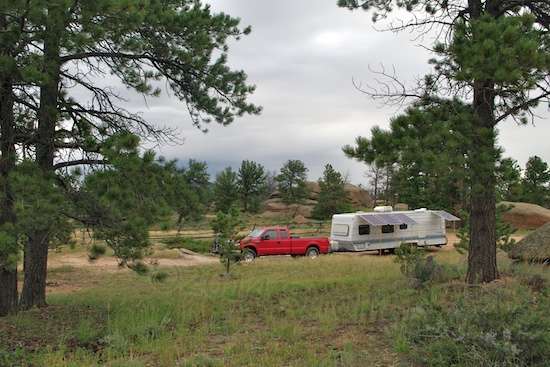
The Defiant, in her secret lair.

The Defiant, in her secret lair.

Another double-length drive through Nebraska got me to the Medicine Bow National Forest in Wyoming, at sunset. To boondock there, you go past the entrance for the Vedauwoo Recreational Area, which is a very nice paved campground and picnic area, with walking paths right up to some of the finest climbing cliffs I’ve ever seen. The day use area costs $5/day, and camping (without any hookups) is $10/night. I’m not dead sure any of the spaces will fit the Defiant, but there is some accommodation for larger rigs.

After a tour down several miles of the worst washboard gravel road I’ve seen to date, I managed to find a spot to turn around, and wound up pulling into the same area I stayed at last year, but in a position that would limit exposure to mud if the weather turned bad, as had been forecast. It was dark by that time, and quite late, so the evening celebrations were curtailed a bit.

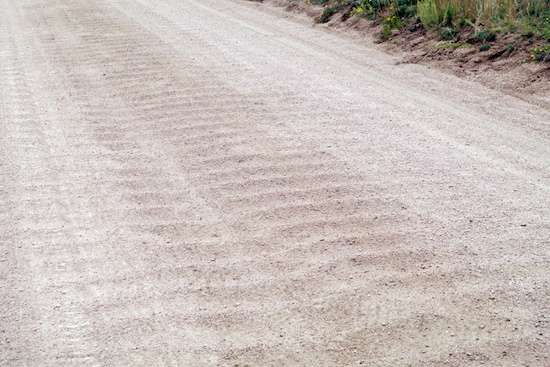
This is hardpack, and with a stiffly-suspended vehicle, it's time to rock and roll. A normal one can skate over this at 30 MPH or so, but the result of doing that with the F-250 and trailer is not so good, at least at tire pressures that will handle the weight.

This is hardpack, and with a stiffly-suspended vehicle, it’s time to rock and roll. A normal car/truck can skate over this at 30 MPH or so, but the result of doing that with the F-250 and trailer is not so good, at least at tire pressures that will handle the weight. A few miles of this at 1/2 MPH makes the paved fee campsite pretty appealing.

Breaking out the solar panels the next morning on a whim, I hoped to stay 3 nights before moving on – a choice that requires solar power unless I want to live Spartan. I popped the Evelo Aurora off its rack after Read more…

Post Navigation