Strolling Amok

Pops goes on tour.

Archive for the tag “Travel”

Gem Show!

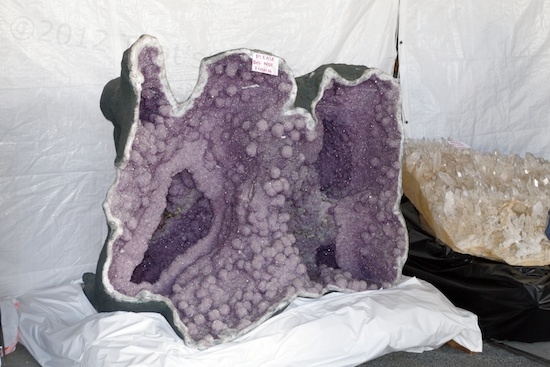
Monstrous geode, Dude!

Monstrous geode, Dude!

Originally posted 1/10/2013

The gem show at Quartzsite is heady stuff for anyone who likes to gawk at rocks, gemstones and jewelry. There are people with tents of all sizes hawking everything from barrels of rocks to vases made from solid rock. Some of it is pretty neat, being handmade by the artist. Much of it is things like large pieces of transparent amber imported from around the world. And much of it is simply purchased carved products unpacked from cartons originating in Read more…

Packing ‘Em In… Not!

IMGP4070wtrmkd

Originally posted 12/27/2012

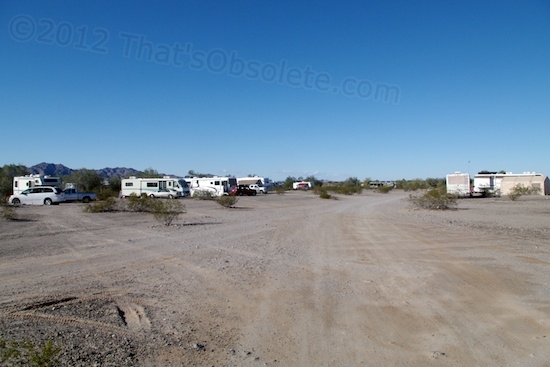
The image above shows the most crowded area in my section of the LTVA. Not very impressive so far! I was talking to a couple at the RV watering hole a couple days ago, and the husband was very surprised at the comparatively sparse number of campers this year, at this point in time. It’s been gradually dwindling, but I have to wonder if vendors can afford to show up and pay fees if ain’t nobody here come start of the year. All this is fine for me personally, as it limits the load on the local water supply and waste capacity, and I’m not looking to party hearty or wedge myself into a lot of vendor tents. The core of this thing is the gem and rock shows, and heaps of RV-related vendors round it out a bit.

It’s Up!

One of many valet parking stations at the toney Biltmore Fashion Center in Phoenix.

One of many valet parking stations at the toney Biltmore Fashion Center in Phoenix.

Originally posted 12/19/2012

No surprise, the iMac is back on its feet after a day trip to Mac Service Experts in Phoenix. They replaced the defective Seagate HDD under Apple warranty and restored it using my backup drive, again at no charge. Word on the street is that even Seagate’s replacement drives are occasionally failing, which in my guess places Apple in a difficult and potentially costly position. I’m hoping that they change HDD suppliers, but that’s just me.

While waiting, I went out for breakfast, hit a local Ace Hardware for some tubing for a future fresh water tank filter install, and toured the nearby Biltmore Fashion Center. It’s a bit like the Oakbrook Shopping Center in Illinois, but with less open space between the rows of stores. The South side is packed with valet stations and gated validation parking areas, so I wedged the F-250 into a slot in the freeform riff-raff parking on the  Read more…

Big Doin’s at the LTVA!

Originally posted 12/12/2012

Oh my, yes. While you have been imagining my going comatose of boredom out here, this area has been sparkling with activity, in a low-key turtle-crawl sort of way. More campers have been trickling in, in preparation for the numerous shows beginning in January.

I'm halfway down my driveway and, as always, admiring my new home. Sorry. Can't help it.

I’m halfway down my driveway and, as always, admiring my new home. Sorry. Can’t help it.

I heard a buzzing overhead a week ago, as in the straining of an overworked little motor. Stepping outside, I saw two ultralight aircraft soaring past.

Engine wailing, this little craft worked its way through the sky.

Engine wailing, this little craft worked its way through the sky.

Notice the jet and its trail. As is always the case, the more primitive form of transport gives the true sensation of flying high above the ground, while the technological approach insulates one from the wonderment of flight.

Notice the jet and its trail. As is always the case, the more primitive form of transport gives the true sensation of flying high above the ground, while the technological approach insulates one from the wonderment of flight.

And today, a road grader worked the Old Yuma Road, the main dirt pathway through the La Posa West Long Term Visitors Area. That was totally unexpected, and will transform the rock-strewn, diving  Read more…

The Painted Desert Inn

Originally posted 12/11/2012

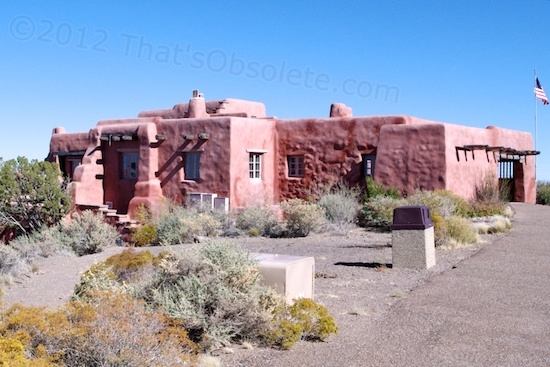
The Desert Inn was originally built in 1919 from petrified wood and clay.

The Desert Inn was originally built in 1919 from petrified wood and clay.

Originally posted 12/11/2012

When the Painted Desert Inn inside what is now the Petrified Forest National Park was first built in 1919, the site was “unappropriated federal land”, and Lore was essentially a squatter. However, the Homestead Act of 1862 allowed people to claim a federal land grant once residency was established. Magnanimity was not the core motivation here. The Homestead Act was actually a pre-war struggle between slaveholding and free states to extend their own type of territory. The economic advantages of using groups of slaves in farming represented a competitive threat to northern “free soil” farmers who had to pay for their help, and they wanted the further extension of slavery stopped. The territories now known as the Western states were developed as free soil states under the Homestead Act only because the Southern states seceded in 1861, and so stopped blocking its passage by the Northern Congressmen.

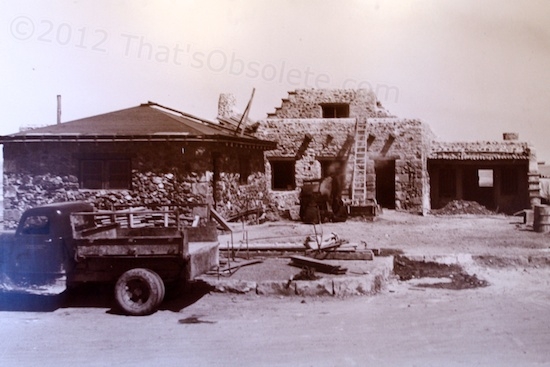
The reconstruction of the Painted Desert Inn in the late 1930s.

The reconstruction of the Painted Desert Inn in the late 1930s.

Lore registered his inn under the Homestead Act in 1924 with the nickname of Stone Treehouse. It was very different from the Desert Inn that followed it, having its main entrance facing the desert view rather than the access road as used today. Subsequent reconstruction has left the original entrance intact though, in the same way that the “Brickyard”, the Indianapolis 500 racetrack, has left a yard-wide strip of the original 1909 brick paving exposed at its start/finish line. round this this entrance in back, the original stacked petrified wood construction can be Read more…

The Crystal Forest

IMGP3566wtrmkd

Originally posted 12/9/2012

The Crystal Forest area of the Petrified Forest National Park is not the only one containing petrified logs, but it is the best and the most accessible one. There is a narrow paved path looping through it. I think the pictures say it all, but experiencing the Crystal Forest in person puts in on an entirely different level. The theory is that a huge area of water flow through a primordial forest eventually caused a vast logjam to accumulate, and this is the end result.

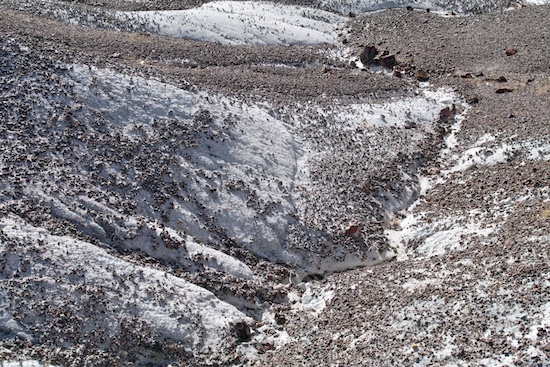
This looks like a shot down into a distant valley, but it's actually just the ground below my feet.

This looks like a shot down into a distant valley, but it’s actually just the ground below my feet.

Actually, it’s only a portion of the end result. In 1853, a military surveyor arrived and wrote that one of the tree trunks “measured ten feet in diameter”. That’s long gone. A steady stream of visitors and commercial interests have looted  Read more…

Roadside Vistas

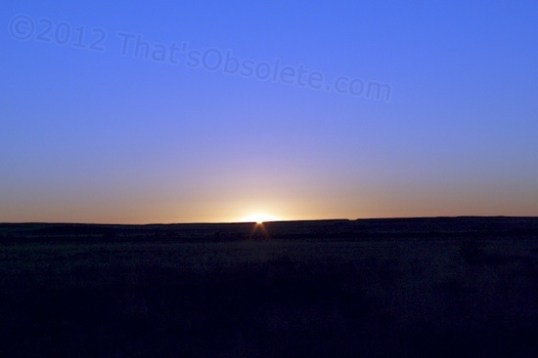
Sunrise at the Petrified Forest National Park.

Sunrise at the Petrified Forest National Park.

Originally posted 12/5/2012

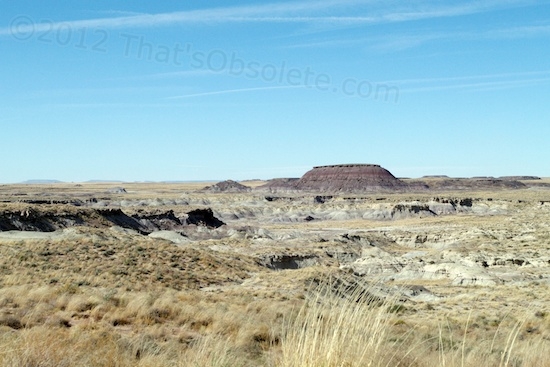
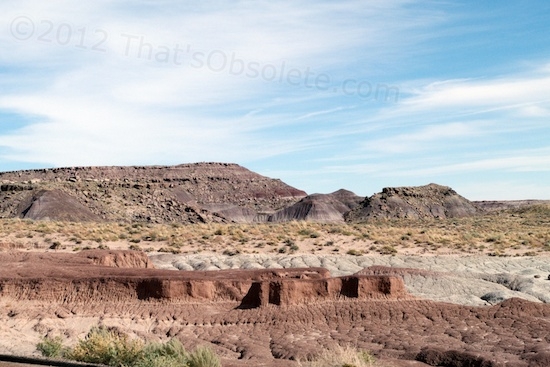
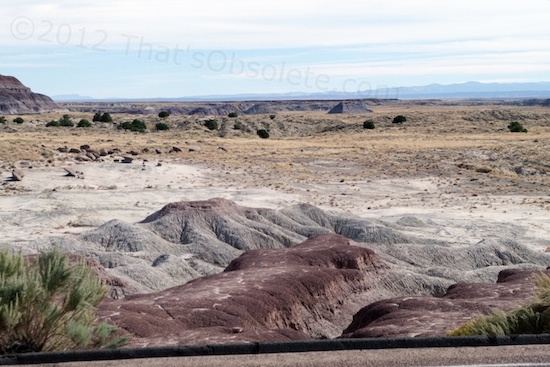
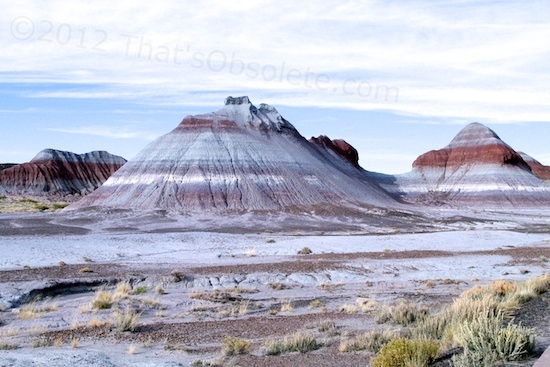
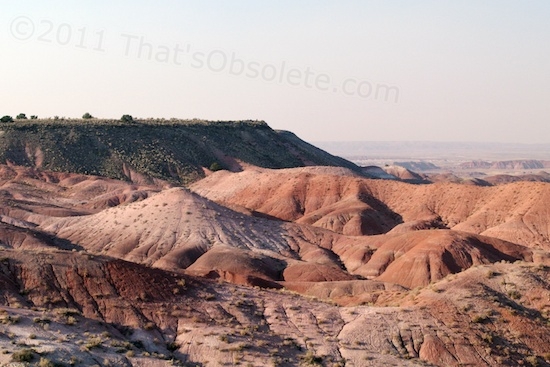
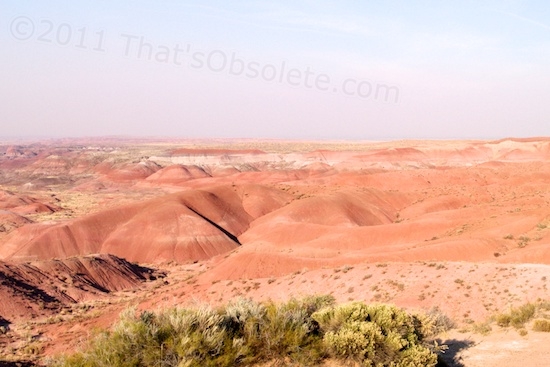
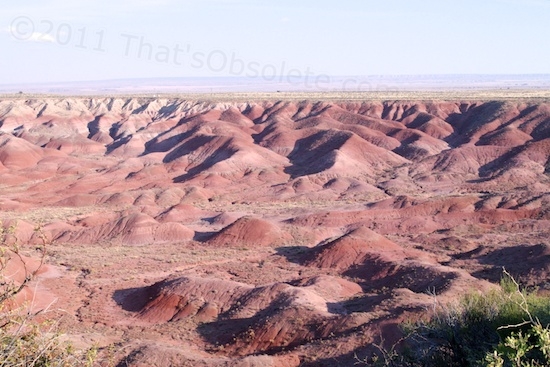
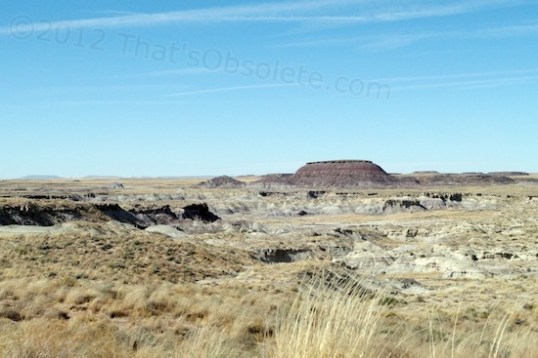
Tuesday, October 23rd was my first full day of touring the Petrified Forest National Park. I’ve mentioned the driving views from the road that goes through the park. Maybe it’s the economic depression that we don’t officially have, but not many people are at the park these days. I’m told that the prime season ended in September. At any rate, traffic along the roadway is almost nonexistent. For the sake of really taking in the scenery, that’s good, because there are very few places to stop at roadside, since there’s no room for a gravel shoulder. When you want to stop and gawk or take a holiday snap, you have to barely drop two wheels off, or just stop as-is. Either way, you’re blocking your lane. With no one in sight for several minutes, this is not an imposition.
IMGP3542wtrmkd

But the view is always worth the stop, however awkward. I’m just going to paste a few pics here, but take note that the park road contains much, much better – they were located in a potentially dangerous section of roadway as it wound tightly up and down between badlands hills. With no place to stop safely, I have the memories, but no photos.


IMGP3543wtrmkd


IMGP3544wtrmkd

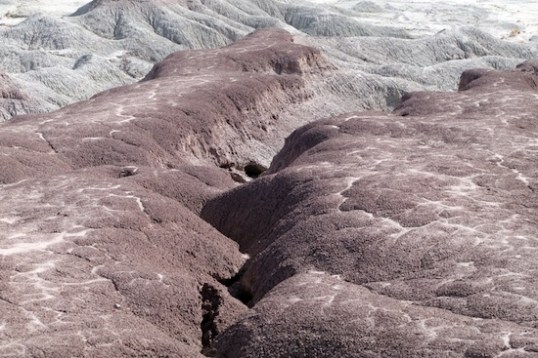
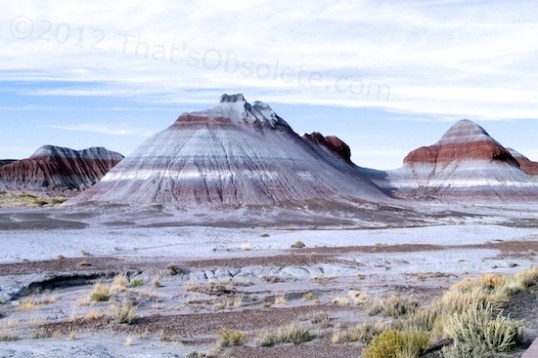
Below is a closeup of the one above. The badlands areas are fascinating because they challenge our sense of scale. The mounds and gullies often look like an aircraft view of mountains and valleys, even up close. An HO-scale model railroader would go nuts in here.
 

IMGP3545wtrmkd

IMGP3578wtrmkd

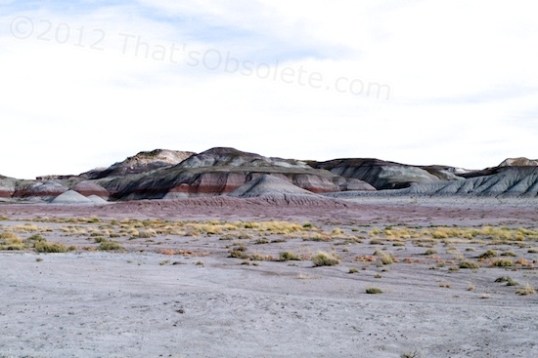
This is why it seems an absurdity to me to try to blow through this park in an hour and then say, “Yeah, been there.” Safe or unsafe, you have to stop.

IMGP3580wtrmkd

IMGP3581wtrmkd

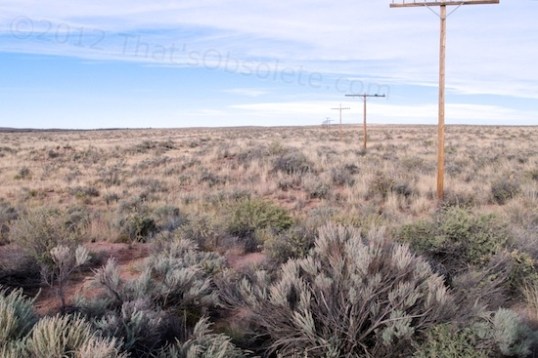
During the day, I headed nearly all the way up to the north end of the park to see where old Route 66 went through. The road wasn’t there any more, but the telephone poles were.
This is where old Route 66 passed through the park.

This is where old Route 66 passed through the park.

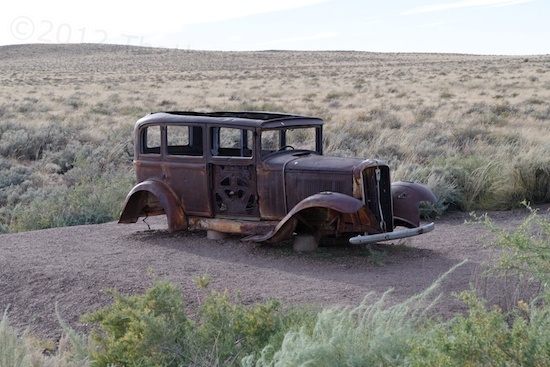
A railroad still passes through near the location of the old highway. The Park claims not to have torn out the highway, which despite appearances is so because the unused power poles are still there. I have no idea of whether this section of 66 was ever paved, so it’s possible that it was simply grown over, but I would have expected to see some remnants asphalt.

An early Ford perched on cinder blocks commemorates the location of the highway.

An early Ford perched on cinder blocks commemorates the location of the highway.

Actually, this “Mother Road” of song and TV show, had a mother. It was the National Old Trails Highway, also called the Ocean-to-Ocean Highway. It went from New York to Los Angeles, pieced together from parts of the Cumberland Road, Santa Fe Trail, railroad track frontages, ancient American Indian trails, plus some new connecting pieces. So Route 66 was merely the most recent incarnation, taking on sections of various dirt tracks, the N.O.T.H. included. If you were driving through prior to 1926, you wouldn’t be on Route 66, since it hadn’t been commissioned yet. I’m not certain you’d be on the National Old Trails Highway here, either. I suspect that this particular section originated as a railroad track frontage road, because the nearest piece of National Old Trails Highway converted to 66 has been described as starting further westward, at Las Vegas, NM and running to the Pacific.

There’s not much point in being pedantic about it though. Parts of Route 66 were swapped around since its beginning, and trying to retrace the old road in a nostalgic drive can be problematic, and not just because of collapsed bridges, torn up sections, a ton of dead ends, and privately-owned land. In some areas, you face a choice of which of three routes of Route 66 you wish to follow. It ain’t easy because, except for commercial signage inside some towns, none of it is marked in any way, and the original path has frequently been obliterated in order to cross over or act as a frontage road to the Interstate that replaced it. Business is business, and Federal and State DOTs don’t have much of a sense of nostalgia when new construction will provide a better solution than the old.

I can attest that if you think you can discern what’s Old 66 and what isn’t by pavement appearance and direction, you’ll probably guess wrong. I only dabbled with small bits of it a couple of times, when it was handy. Despite having rudimentary documentation onboard, I frequently found myself thinking either, “I can’t believe this isn’t 66 right here, it looks right and makes sense”, or “I can’t believe this is Route 66!?! Narrow, flooded areas, zero shoulder, guardrails right at the pavement edge. This is a glorified cow trail. The directions must be wrong.” But they aren’t.

I suspect that many online Route 66 guides are winging it now and then, but it hardly matters. Nobody, not even me, is going to try to retrace every mile still available, backtracking down 20-mile stretches of unmarked dead ends over and over. Such a painstaking journey would take more months, fuel, patience and money than anyone has. Not to mention the difficulty of having to reverse direction in anything bigger than a car, since there are precious few dead ends with anywhere to turn around nearby. Still, driving a small piece of old 66 here and there is often a fascinating and fun exercise, if you’re in no rush to get somewhere.

Petrified Forest Arrival

Originally posted 12/3/2012

I didn’t mention in my previous post that the Painted Desert Visitor Center at the north end of the park did offer an orientation film about the park, but with time being limited, I passed. I was too excited about actually being at the park anyway. Having seen “stereoscopic” slides of a few petrified logs when I was a kid, I wanted to be inside it. I had expected my “America the Beautiful Interagency Lifetime Senior Pass” to let me through the gate at half price, but I had happily misunderstood the terms. I was admitted at no charge. Being a certified cheapskate, that did my heart good.

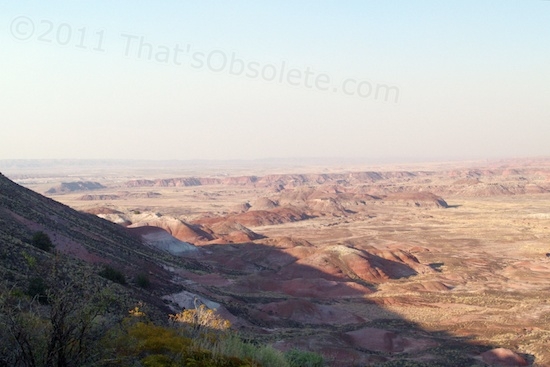
The road traversing the park was paved and in fine shape, with posted maximum speeds varying from 35-45 MPH, but towing the trailer over the uneven surface dictated lower speeds. Fortunately, traffic was almost nonexistent, so I wasn’t holding anyone up as I trundled along. Since I had a little time to spare, I couldn’t resist stopping at a few viewpoints or outlooks over the Painted Desert area.

IMGP3534wtrmkd

IMGP3535wtrmkd


IMGP3537wtrmkd


IMGP3539wtrmkd

I found that the main road’s outlooks were complemented by several side roads along the way, which led to other viewing areas with distinctly different features. Even without stopping further, the vistas and geological features along the main road itself were awe-inspiring.

The park’s size and variety of features were much bigger than I had mentally pictured, and I realized that it would take me several days to see even the majority of what it offered. The park’s printed guide offered suggestions on what to see if you had one hour, several hours, half a day, and one day or more, but this seemed seriously out of sync with reality. Seriously. Even with a fast car, the stamina of youth, great physical condition and running shoes, there would be no way to gain any real appreciation of the park’s features in half a day.

This wasn’t something to go flying through, like a slideshow. It was to be savored for the experience itself. That became obvious right off the bat. The faster you’d go through it, the less you’d be able to appreciate what it is that you were looking at. You could check it off your bucket list, sure, but that’s about all you’d get out of it. In the rush, you wouldn’t really have seen or experienced it. That would be a shame and a waste, because what is here is nowhere else in the world.

It was time to move on and set up camp. Camping is not allowed inside the park, except for tenting out in the open wilderness areas where walking is the only access. My goal was to find a parking spot at the Crystal Forest Gift Shop, located just outside the South park entrance. When I arrived, the shop was closed, but a large “Free RV Camping” sign and a generous parking area with electrical hookup boxes made me feel less like I was clogging up some poor businessperson’s parking lot. Being a rank newbie with 26′ box behind me, I took my sweet time backing the travel trailer into a spot. I could afford to, since no one else was there and I had the whole thing to myself.

The house batteries were fully charged because of the day’s travel, and I cooked some dinner and settled in for the evening. I might be unable to recharge anything but the house batteries, and had no idea how long the water or waste tanks might hold out, but I was officially boondocking. And, electricity was available if the length of my stay would make it necessary. Or, so I thought.

Petrified Park Prelude

The first geological eye candy in New Mexico appears ahead.

The first geological eye candy in New Mexico appears ahead.

Originally posted 12/2/2012

On Monday afternoon, October 22nd, I was hell-bent on making it to the Petrified Forest National Park before it closed. Why? Nothing was on the GPS, since there are no towns or major roadway intersections nearby. Just an exit number. Old school. Miles-to-go and travel time unknown. I knew I’d have to get to my intended camping area, a gift store parking lot outside the park limits, by driving South through the park, a distance of some 28 miles at low speed. And that single path would be gated off at some uncertain time.

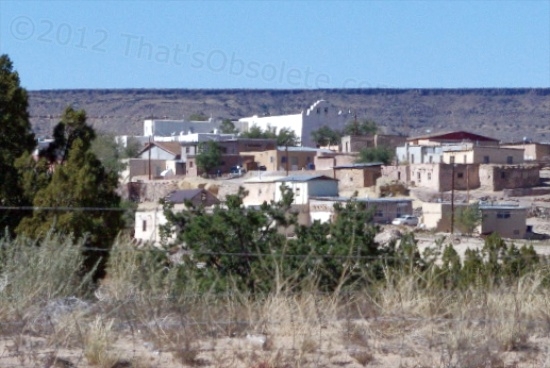
I’d spent an impressive, if not scenic, morning gaining more and more altitude as I worked my way westward. An endless round of stair-like hills posed no problem for the F-250’s twin turbos, but the price was a dismal average of 8-9 MPG. At last the climbing stopped, and the first inspiring scenery presented itself before me. After awhile, I answered a bladder call and pulled over at a rest stop along I-40. It was a puzzler, as a dirt road town a mile away presented a large cluster of small adobe houses with no apparent access to the highway. A row of abandoned wooden vendor shacks sat behind a wire fence right in front of me, along with a sign prohibiting vending. A sign marker identified the location as the Laguna tribe of American Indians.

An interesting town, but you can't get there from here!

An interesting town, but you can’t get there from here!

The sign pointed out the Spanish mission church of San Jose de la Laguna, built about 1706 by one Fray Antonio Miranda. Apparently made of adobe too, it had been repaired numerous times, the most recent being 1977. With claimed interior walls of whitewashed mud and a dirt floor, its ceiling is a herringbone pattern of finished wood.

From this distance, I could barely make it out despite its large size. I had only the wide 18-55 lens on my camera, and both my telephoto lens and my binoculars were packed away in the trailer.

Oh, I think I see the mission church at this point, revealed here just to left of center.

Oh, I think I see the mission church at this point, revealed here just to left of center.

The town struck me as impoverished, since it looked to have remained somewhat unchanged since the 1700s, and the citizen’s entrepreneurial spirit of outreach had apparently been dashed by The Man, in the form of the state’s Department of Transportation. It looked fascinating and I had an impulse to head over there, but there appeared to be no convenient way. The scale of its unpaved streets seemed to make the idea of hauling a 26′ trailer through them a bad one and, the clock was ticking.

The San Jose de la Laguna Mission rises above everything else.

The San Jose de la Laguna Mission rises above everything else.

Something in me wanted to go there, but it appeared to be an impulse whose time had not yet come. I pulled back onto the Interstate, and kept an eye out for a nearby interchange. Nope. There were a couple after some miles, both including casinos under huge white vinyl tents.

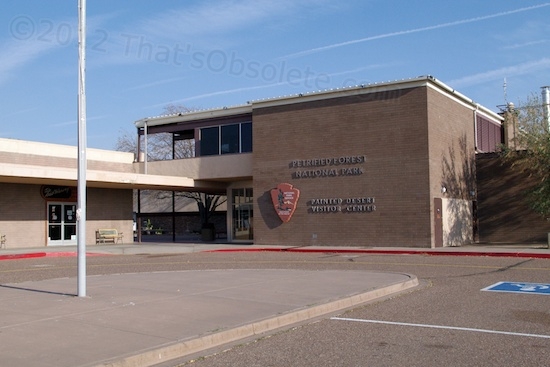
I pressed on with my old school navigation methods, and enjoying the mountain scenery. At last I crossed over into Arizona and kept an eye out for Exit 311. Lo and behold, it appeared and I took it. It was an access road to the Visitor Center at the North end of the Petrified Forest National Park. Some distance in was the parking lot for the building, and I got the oddest mini-thrill simply by catching first sight of the building itself. Regardless of when it may have been built, the architecture and signage were so “modernistic” 1950s-1970s that I could have seen exactly the same thing if I’d visited as a small child, and been impressed with how futuristic it appeared. Being so used to Illinois pavement, even its parking lot impressed me. Generously sized, smooth, and flawless, seemingly untouched since it was first laid down. It was the same aura that Disney World has. Sort of a contrived perfection that never really existed.

Super-cubic, with intersecting planes and big-glass, plus ultramodern signage, were very striking in their time. The contrast of planting something like this in a historic area made a statement that seemed to say, "You're in the right place. However desolate this place might be, we got it under control".

Super-cubic, with intersecting planes and big-glass, plus ultramodern signage, were very striking in their time. The contrast of planting something like this in a historic area made a statement that seemed to say, “You’re in the right place. However desolate this place might be, we got it under control”.

I parked and wandered into the Visitor Center, expecting displays or something to look at, and also hoping to see a clock to check the local time. There was a rack of brochures, and a uniformed lady behind a counter who seemed slightly confused as to why I had come in.

As it turned out, she was entirely correct. Apart from the small and equally historic Fred Harvey restaurant onsite, these were strictly administrative offices. What archives and artifacts they did have there were not open to viewing by baked out, mouth-breather yokels like me. All the tourista stuff was housing in the other end of the park. It would take most of an hour to traverse and exit the park at the other end. I had about an hour and a half before the steel gates would slide shut and the pistols be drawn. I climbed back into the mighty F-250 and headed for the entry gate, travel trailer in tow.

Mucho Thrashing, Nada Accomplished

Originally posted 11/21/2012

The almighty solar controllers finally arrived this morning at a UPS Customer Center in Blythe, California, about 23 miles away! They have the customer desk open from 9-10AM each weekday, and that’s it. It’s really a distribution center. My shipment arrived a day later than expected, but it did arrive, and now awaited my tender approach. I got up for the day, emptied the waste tanks into the Tankmin truck-mounted tank, and refilled the fresh water tank in the camper before taking off. I had plenty of time to visit the dump station in another associated camping area, so I took off for there.

Upon arriving, a sign announced that the dump station was closed. I wanted to see what the story was, so I drove the extra 0.8 miles and saw nothing except tape strung across the entrance poles. Back at the check-in shack, the guy there said that the underground tanks had filled, and that the Ranger had been notified and had likely already called a tanker truck to dump it out. It would be serviceable again before the end of the day.

I wasn’t that enthused about hauling a full Tankmin all the way to Blythe and back, mainly because it had clogged before and I wasn’t sure that sloshing it all that way wouldn’t encourage heavier sediment to settle in the hose again, and plug it. I hit what was alleged to be the cheapest commercial dump station in town and my Inner Scotsman kicked in when I saw that the charge would be $12. Hoot mon, I’d r-r-r-risk the trip, aye.

So I tripped on down to Blythe, wondering at the average indicated fuel mileage of 24 MPG. A lot of it was downhill, but still… I was so pleased when the UPS center was before me, and I walked up  Read more…

Post Navigation