Strolling Amok

Pops goes on tour.

Invariably Variable Reloaded
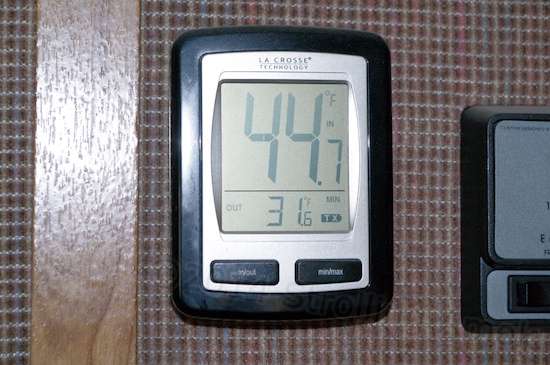
Yowza! My thermometer this morning indicated a cabin temp of 45, and outside a crispy 31 degrees!

Yowza! My thermometer this morning indicated a cabin temp of 44.7, and outside a brisk 31.6 degrees!

This post is just to show that now and then, weather in the Great Southwest varies from the usual sunny-and-hot broil that we all associate with it. I do, anyway. I’m normally much more centered on avoiding a nicely-baked dehydration than I am anything else, so it can be a nice change of pace to actually get some weather here, which does happen. This morning’s outside temperature is nothing compared to the Midwest where I come from, but everything in my little self-absorbed world now revolves around getting along in a “temperate weather only” travel trailer where, during its design phase, the word “insulation” was a token term mumbled incoherently, if at all, in the engineering meetings. Ever seen what an inch of poor quality fiberglass insulation looks like? It looks much like a fiberglass furnace filter. You can almost read a book through it. After a 12-hour overnight cold soak, cabin temps are typically 10-15 degrees above ambient. With no cloud cover, daytime temps will usually peak at 5-10 degrees above ambient, too.

Situation normal. More clouds than usual, but this is one day's view from the trailer, looking eastward.

Situation normal. More clouds than usual, but this is one day’s view from the trailer, looking eastward.

Compared to a more contemporary trailer, these numbers are pretty bad for a brief overnight exposure. But, they are not too shabby compared to an uninsulated van or other similar approach hurriedly pressed into service as a camper. Thus the unending hunt for finding an elevation that will provide a livable average as the daily temperatures do their 30-40 degree swings up and down. How picky you have to be depends on a mix of one’s wimp factor (in my case high) and the camper’s insulation effectiveness (in my case low-to-moderate). Several places I’ve been to out here have provided residents who justifiably think the world of their town and area, and who have, during a conversation, effectively invited me to Read more…

Invariably Variable

Hard to see, but those white spots are snowflakes! The sleet came later.

Hard to see, but those white spots are snowflakes! The sleet came later.

Having just come out of a time where I could only walk in the mornings because the afternoons here near Paulden were too sweaty in the hot sun, I was surprised to wake up this morning to the 46-degree temperatures dropping instead of rising. In fact, the consistently light overnight rain changed into moderately heavy snowfall in the 35+ MPH winds as the temperature dropped to 41 degrees. Then up to 44 as the trailer rocked in the wind, then back down to 42.Eventually, the snow began to stick to the Ford for a few moments, but never had a chance on the ground.

Then the heavy, dark overcast broke up to billowy clouds, and temps cruised up to the mid-fifties. That was it, or so I thought. I thought that until noon when Read more…

In Search of Pavement

A dawn, just like any other dawn, but one now beckoning the quest...

A dawn, just like any other dawn, but one now beckoning the quest…

Just think of this as relating to the brick and mortar Retailing Mantra “Location, Location, Location!” Just what is it I’m parked beside? An early major US highway, and yet seeming to waffle between one lane and two, and between pavement and dirt with some gravel thrown on top. Following terrain, but with some filling in and some cutting away – with some of the lesser cutting into grades unnecessary for motorcar travel. It’s hard to tell just what this section of 89 was originally like. Its present inconsistencies make it a confusing mish-mash of contradictions, like building a series of top-quality, engineered concrete overpasses, only to link them with a dirt path made out of landfill debris. Was this a highway, or a piece of local trail pressed into service as a stopgap?

I had gone for a walk, picked up some indicators, and then picked up more during a drive on errands. Between that and running into a Read more…

It Ain’t Just For Show

I was in shock for about five full seconds and then careened over to the shoulder.

I was in shock for about five full seconds and then careened over to the shoulder to snap this.

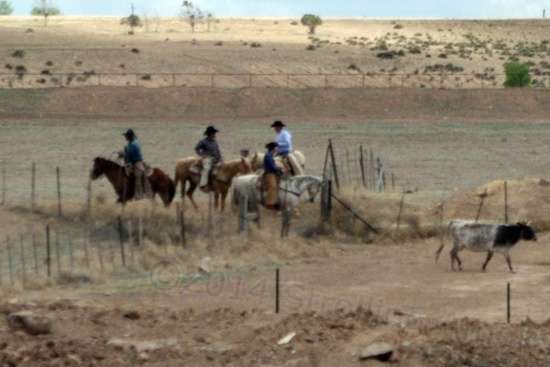
Remember the recent post about team roping? I wondered about whether this event was now a hobby/sport unrelated to today’s realities about cattle farming. You know, mechanization, efficiency, feedlots. On my way back from a grocery run to Chino Valley, I unexpectedly found the definitive answer to my quandary. A good-sized herd of cattle was moving toward an underpass running below the roadway on 89. Lo and behold, what was moving them was a group of four mounted riders! Groping blind, I could not locate the camera behind the passenger seat. Damn! With traffic tailgating me at 65 MPH, I yanked it over onto the road’s paved shoulder near a roadside historical marker, and hit the 4-wheel discs bigtime.

I realized an issue as I reached for the camera again. Wrong lens. They’d be little specks at this distance. So I’d have to switch it on and use the menu system to ramp up resolution, and take my shots. Then I’d have to crop the heck out of the shot later, but at least I could. The road’s shoulder was tilted pretty good, and the Ford’s heavy door was a challenge to get open, but desperate men do desperate things. I expected the Pentax’s LCD display to wash out in the strong light, making the resolution adjustment tough. But no, it was readable, and fortunately Pentax had not buried the adjustment deep in the menu system. Done in a few seconds. Aim and fire.

I only caught the very end, but hey, it’s proof that here and there, the Old West is still the Real West.

I think I know a couple people who'd pay to be allowed to do this!

I think I know a couple people who’d pay to be allowed to do this!

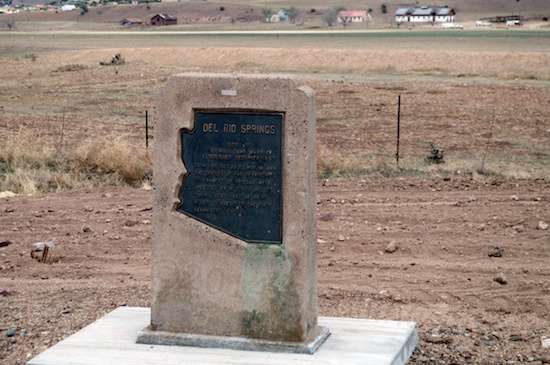
By the way, the historical marker reads: "Del Rio Springs Site of original Camp Whipple, established December 1863. From January 22 to May 18, 1864 the offices of the territorial government of Arizona were operated from tents and log cabins here, before being moved to Prescott, the first permanent capital."

By the way, the historical marker reads: “Del Rio Springs
Site of original Camp Whipple, established December 1863. From January 22 to May 18, 1864 the offices of the territorial government of Arizona were operated from tents and log cabins here, before being moved to Prescott, the first permanent capital.”

Are We There Yet?

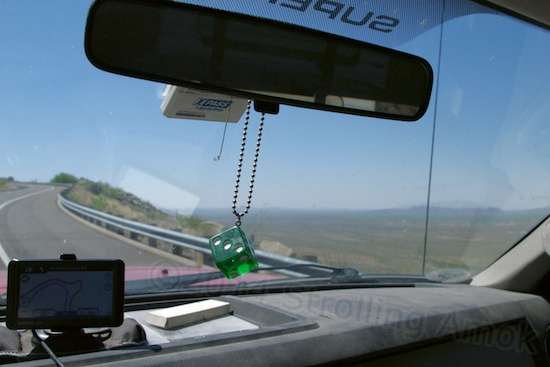
Well, besides highlighting my dusty dashboard, rearview mirror with unlucky die, GPS and expired I-Pass tollway gizmo, the other emphasis here is the rapid climb from Congress toward Prescott, AZ.

Well, besides highlighting my dusty dashboard, rearview mirror with unlucky die, GPS and expired I-Pass tollway gizmo, the other emphasis here is the rapid climb from Congress toward Prescott, AZ.

Soaking in heat is not my idea of fun times, so as Wickenburg heads toward a high of 89 today, the tiny townette of Paulden, AZ is expected to reach just 79 degrees. It’s the higher altitude. I’m just north of Paulden, parked beside a section of “Old US 89”, a bypassed portion of what is now State Route 89 that runs from Congress to Ash Fork. “What to what?” you ask? From what I can tell, US 89 used to run from Mexico to Canada. Since then, it’s been chopped, abandoned, and incorporated into other highways. Information on my little piece of it is especially hard to come by. But let me start at the beginning of the day’s journey.

As long as the pavement is reasonably smooth (and what isn't after driving in Illinois?) I find piloting the Defiant toward the next destination to be a pure pleasure. Looka that terrain!

As long as the pavement is reasonably smooth (and what isn’t after driving in Illinois?) I find piloting the Defiant toward the next destination to be a pure pleasure. Looka that terrain!

The total distance is around 100 miles and takes about 2.5 hours, in theory. The most direct way to head from Wickenburg to Paulden is to take the short stint on 93 from Wickenburg north to Congress, then just stay on 89 to and through Prescott and points north. Naturally, with the Defiant in tow, I can’t do that – just south of Prescott, 89 turns into a twistfest that takes rigs over 40 feet into nightmare territory. Such vehicles are prohibited, and articulation doesn’t matter. Fitted for intergalactic travel, the Defiant measures Read more…

Wickenburg Textures

Some desert areas are nearly barren, while others aren't.

Some desert areas are nearly barren, while others aren’t.

This post could just as easily be titled “A Farewell to Wickenburg”, because it’s definitely getting toasty here, and higher altitudes beckon. So, today I hope to be packing up, hitching up, and reluctantly moving on.

I’ll miss this area not only for it’s beauty and equine orientation, but I’ll even miss that long climb from downtown up the four miles to camp. Kinda, anyway. Whatever day I’d bike on an errand to town, I’d see at least one cyclist on a road bike working their way uphill. They use this thing to keep in shape. Naturally, they weren’t Read more…

Team Roping Competitions

Caution: The post below contains a large heap of photographs. If your data plan is extremely limited and you usually use it all up each month, you may want to NOT click on the “More” icon to keep reading (or view the brief video) because all of the photos will begin to download with the rest of the article. There are some very nice snaps in it, if I do say so myself. The photos illustrate how things work and what often happens. Reduced to blog size, each photo is tiny space-wise, but there are about 100 of them, so they add up if you have no space at all to spare. If you already squander your monthly plan on occasional photo galleries, YouTube or Facebook, make a vow to watch one less video of a monkey picking its nose, and keep reading this instead.

Once a steer is too large for one man to handle, team roping comes into play.

Once a steer is too large for one man to handle, team roping comes into play.

Wickenburg, Arizona still wears its Old West heritage on its sleeve, and for good reason. It’s still a ranching and equestrian town. As a result, each winter from November to April, there are numerous team roping events in any of several arenas in town, public and private. Team roping is a rodeo event that contains one steer, two mounted riders, and a couple of ropes.

The historical goal is to quickly capture and immobilize a full-grown steer too large for one man to handle alone. To do this, the first rider tries to rope the steer’s horns, head or neck, while the second rider must rope both of the animal’s rear legs. Once the two pull far enough apart that the steer is judged as immobilized, the elapsed time is called. Team roping is about the only rodeo event where gender means nothing. It’s a straight-up race against time and other teams.

Notice that the rider on the left has thrown his rope while the steer's rear feet are on the ground, and the very small size of the loop! No way, right?

Notice that the rider on the left has thrown his rope while the steer’s rear feet are on the ground, and also the very small size of the loop! No way, right?

There’s a five-second penalty for roping only one rear leg, and same for either rider leaving the train station early. The equipment is not particularly specialized except for the two ropes. Once you see the photos below, you’ll know why. Each rope does a different job and must behave just so in order to succeed. You’ll notice that the steers are wearing protective horn wraps, which prevent rope burns and reduce stress on the horns. I’m very glad I took plenty of sequential photos, because that made it possible for me to see just how absurdly difficult team roping is to do well. It also helped me appreciate just how much training and experience the working horses must have in order to pull this thing off.

Same riders a couple seconds later, and the impossible has occurred. Both ropes are firmly in place, and completion is about to be called.

Same riders a couple seconds later, and the impossible has occurred. Both ropes are firmly in place, and completion is about to be called.

See, each rider’s hands are full of rope and reins, and maneuvering it with split-second timing is a pretty absorbing task. Naturally, there’s no time for the usual action/response delays once that gate opens, so the horse needs to be able to make a string of executive decisions on Read more…

The Desert Caballeros


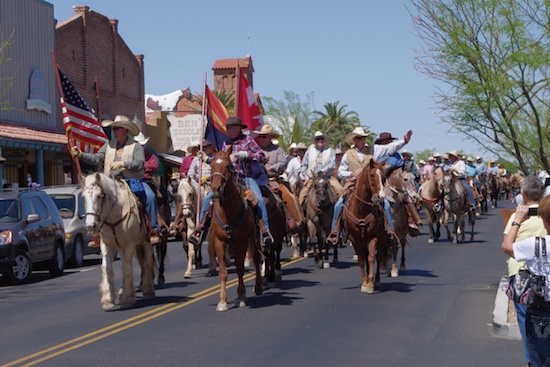
The departure out of Wickenburg.

The departure out of Wickenburg.

Each year since 1947, an event called the Desert Caballeros Ride takes place. An invitation-only event, it provides a couple hundred riders the opportunity to ride and camp in the surrounding mountains for five days, and then it’s over too soon until next year. This year’s 180 riders will split into groups of forty and move between three camps over about 100 miles before returning. This now-historic ride has inspired several others in the area, including one exclusively for horsewomen (who showed their more civilized natures by chipping in for a portable shower).

A few local horses were individually trailered in, and this one of them. What a beauty.

A few local horses were individually trailered in, and this one of them. What a beauty.

So, what I’m presenting here is not a parade through town, per se. It’s simply the orderly departure of some 180 riders heading off for the desert. As Wickenburg is at the juncture of two state highways and lacks a suburban-style network of roads, these boys clog up this town quite effectively for fifteen minutes or so as they head right down the main drags. You’d think the town’s police would view it as an annual nuisance, but not so, not from what I saw and heard. The ride is a part of Wickenburg’s proud heritage, and the town now depends substantially on tourist and vacationer dollars. Although there are other equine events, any loss of interest in this ride would directly impact the town’s ability to promote itself. If anything, it’s in Wickenburg’s best interests to protect and promote it, and that attitude is apparent in the officers having to reroute through-traffic with minimal delay to everyone involved. I was impressed. Calm, confident and friendly, without a hint of grumpiness.

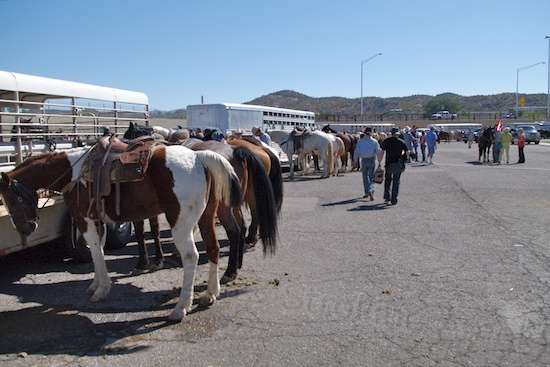
This shows most of the trailers, but let's just say there was a heap o' horsies.

This shows most of the trailers, but let’s just say there was a heap o’ horsies.

More than a few of these riders have been heading out for a couple of decades. Many are local, many are not. The age span runs wide. It’s apparently a good time, and once you’re hooked, there’s no way you’re not going next year. I was able to tour the Community Center’s parking lot among a half-dozen long, long horse trailers, and here is a little of what I saw.

This critter may not win the running or barrel races they hold out there, but he's still impressive.

This critter may not win the running or barrel races they hold out there, but he’s still impressive.

Read more…

A Farwell to Arms?

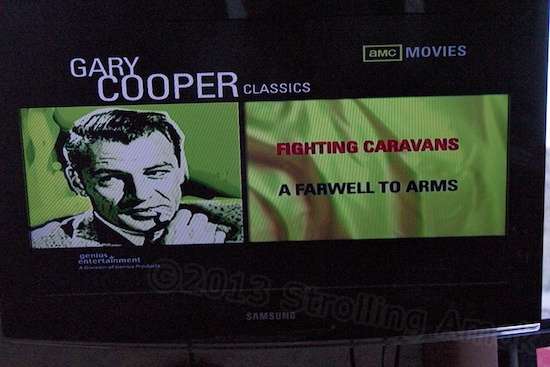
What's wrong with this picture?

What’s wrong with this picture?

Ever notice something minor that just seems to bother you out of all proportion to its physical significance? I bought a DVD at a local second-hand shop, a two-disc pack with three early Gary Cooper movies and a promotional short. Gary Cooper was a popular Academy Award-winning actor with a unique “everyman” style, and who eventually hit a few out of the park, like the classic High Noon. This set included A Farewell to Arms, Ernest Hemingway’s depressive look at love in the midst of the opposing traits of mankind. Except for the breakthrough cinematography, it’s a workman-like effort that deserves some respect – especially for Gary Cooper, who’s the reason for the DVD’s issuance by Genius Entertainment, a division of Genius Products.

Now, a lot of DVDs have misspellings on the electronic disc identification, something only the device will see so it hardly matters. This is the first time I’ve seen a DVD menu muffed with a “don’t care” attitude. It’s not so much the slept-through-that-class miscreant who screwed it up, as the lack of any second set of eyeballs to make sure the DVD was good to go before it went into production. Not a soul in the Genius hierarchy nor AMC bothered to expose it to anyone above a party-animal intern or minimum wage go-fer once the lowest-price graphics house puked up their sloppy work. This tends to kick me right into the standard “and this is what’s wrong in this country today” tirade in regard to business practices, but you get the picture, so to speak. For some outfits, the most effective way to promote themselves is to emphasize cost, and not let anyone see their past work.

Time to Re-Tire


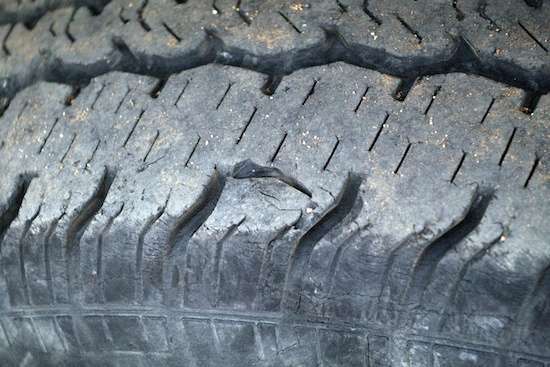
It starts like this, a cut from a sharp-edged rock.

It starts like this, a cut from a sharp-edged rock.

I was in Scottsdale whining about the Ford’s tires to my bud Matt when my eyes fell on an even more pronounced tread loss than I had been lamenting all this time. I had been telling him how I need just one more year over the seven that these tires have already provided, since there is still some usable and legal tread left on them all.

Then squirming under load, more impacts and heat undermine the sun-rotted rubber to tear out a chunk.

Then squirming under load, more impacts and heat undermine the sun-rotted rubber to tear out a chunk.

But time has not been kind to the original equipment tires. Looking decent in the upper Midwest, they took on a parched, cracked appearance the first month they spent some time in the Great Southwest. A week or two (or three) of inactivity didn’t help, since frequent rolling usage circulates compounds in the rubber that keep it healthy. Sitting unused in the strong sunlight simply Read more…

Post Navigation