Strolling Amok

Pops goes on tour.

Archive for the category “Mod Squad”

The Nautical Intrepid

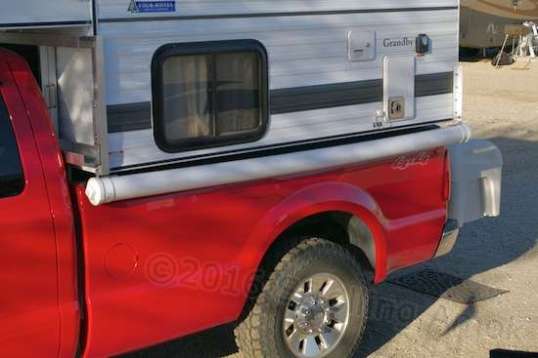
A fishing rod tube, thanks to the FWC Grandby's jack mounts.

A fishing rod tube, thanks to the FWC Grandby’s jack mounts.

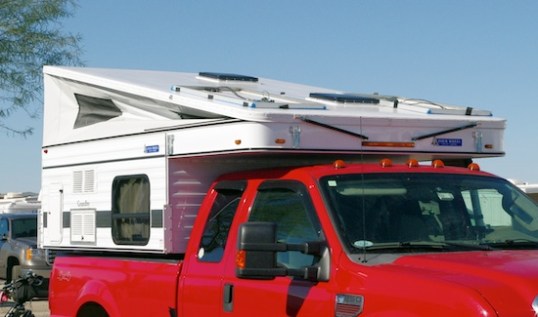
Although I’m currently struggling with bedding options and epic storage issues, I thought it’s about time to document a few of the Interpid’s other mods-in-progress. I don’t plan to fish much mainly due to the cost of out-of-state fishing licenses out this way, but I do want the option to take advantage of the occasional fishing opportunities that present themselves out here. I’ve driven right past various fishing holes along the way and wished I could pull in for a couple of days to try my hand in futility, but the challenges presented by the 26′ Defiant travel trailer always worked against that. The compact Grandby now opens up that option.

Mind you, I’m far from a fish killer. There’s a difference between going fishing and catching fish. In my case, it’s a big difference. But I enjoy the Read more…

Pit Stop Racing

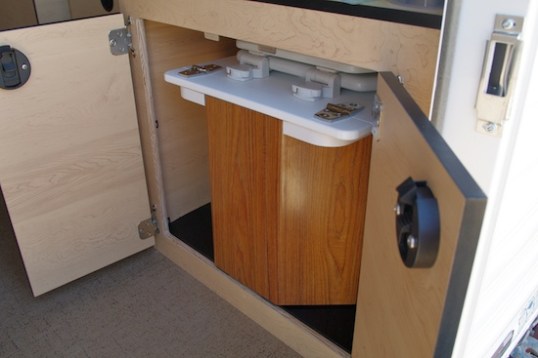
A custom-built low-profile C-Head churnless BoonJon, race-prepped and awaiting the call to start engines.

A custom-built low-profile C-Head churnless BoonJon, race-prepped and awaiting the call to start engines.

A NASCAR racing team known as the Wood Brothers, begun in 1950 and still existing today, made waves in the 1960s and 1970s by altering the ordinary pit stop into its own competitive event. Early NASCAR races were generally short, maybe 100 miles. About the only reason to come into the pit was to repair crash damage or change a flat tire. The latter was accomplished with a bumper jack and a star wrench, and could take a minute to do at full steam. A close race would be lost, but oh well. So pit stops were simply fate or bad luck – except for the Southern 500 in Darlington, which also debuted in 1950. There, enough pit stops were needed that they could skew the finishing results a heap. Smokey Yunick is credited with being the first to toss his bumper jack for a hydraulic floor jack in the mid-fifties, probably because he was already using them in his truck shop. By the time the new Daytona 500 track weighed in in 1959, Ingersol Rand had a rep on hand to hawk pneumatic lug wrenches the following year, and they went over like a keg of rum at a prison camp.

The occasional claim that the Wood Brothers “invented the pit stop” is about as valid as the sloppy journalism behind the claim that Henry Ford invented the assembly line. That a faster pit stop could alter a car’s finishing position was accepted doctrine. That faster pit stops were good was also obvious. What the Wood Brothers did was to Read more…

Intrepid Solar, Part Deux

Have Space, Will Travel. This rack caries two framed solar panels, resting on their sides.

Have Space, Will Travel. This rack carries two framed solar panels, resting on their sides.

Stowing one framed solar ground panel aboard the Four Wheel Grandby is an easy matter. It’s merely a matter of affixing a couple of aluminum angles and wood slats to the bottom of the bed overhang, above the truck’s cab. For a workable presentation of the details, head for Two Happy Campers. Doubling the number of panels presents a clearance problem, however. The panels I have are a bit too wide to fit side-by-side, so that’s out. There’s enough room under there for just about any size of single panel you might care to heft, though higher weights mean you need to pay more attention to exactly how those slide rails are attached to the surface above. As far as clearance goes, there’s plenty available. The combination of the camper’s comparatively light weight and the F-250’s frame strength simply won’t allow the panel-to-roof gap to close much. I wouldn’t expect roof contact during slow off-road articulation either, since the Ford’s roof is curved and negates much of the effect of frame twist in closing up clearances to the hanging panel.

So that’s the “traditional” external storage solution. I opted for an alternate approach: a rack mounted to the Grandby’s Read more…

Intrepid Solar, Part 1

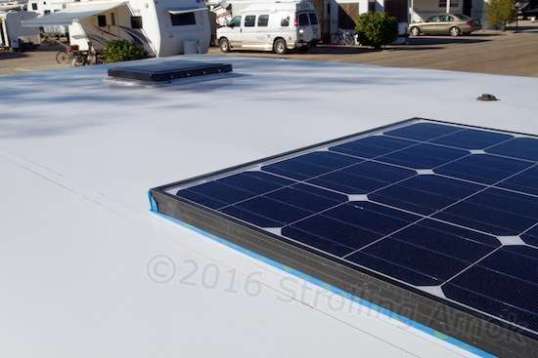
Roof beams marked in pen, the first solar panel is taped to protect paint, and placed about where it is planned to go.

Roof beams marked in pen, the first solar panel is taped to protect paint, and placed about where it is planned to go.

Technically, the Intrepid’s solar system is fully up and rolling. I’m calling this post “Part 1″ because there’s still no place to stow the two Renogy 100-watt ground panels.

This is a long post. The executive summary is that three Aleko 100-watt solar panels and one 60W panel are now roof-mounted on the Four Wheel Grandby, using four pairs of 1.5″ x 1.5″ x 31″ aluminum L-angles that each span three structural roof beams. #8 x 1/2” self-tapping stainless steel screws were used as the fasteners. The roof panels feed a Morningstar TriStar MPPT 45A charge controller liberated from the Defiant, while the ground panels supply an Outback Smart Harvest MPPT 20A controller. A Battery Life Saver desulfator is wired in as well, controlled by an LED-lighted toggle switch. Four 104Ah Sun Extender AGM batteries have been stuffed into the Grandby’s bench seats. A rather complex wiring scheme has been used to minimize unequal draw and charging among the four batteries, with equally elaborate fusing to protect all positive and some negative cables running between the two benches. A 150-watt Samlex pure-sine inverter handles all AC power needs. There you go.

For those of you who are gluttons for punishment, here’s the nitty gritty. I was originally going to install one of Read more…

Fascination

The Chamber of Horrors.

The Chamber of Horrors.

A fairly high wind today makes outdoor work more challenging than it needs to be, so I’ll cover what turned out to be one of the easier mods. Standard fare for a Four Wheel truck camper tends to be Thetford’s 260B, a 2-1/2 gallon Porta-Pottie. At about a hundred bucks, it’s the preferred way to go for camping use, as it can go several days before needing a dump station or a vault toilet where emptying is not prohibited. A very few folks enjoy skulking into gas station restrooms with their Porta-Potties to void their treasure hold. Thanks to the Defiant, I have extensive experience in the vagaries of locating dump stations and dealing with them. In the new rig, I’d like to see if it’s practical to avoid that process, and the adjustments to travel plans that it requires. I’d also like to avoid the limited service life that conventional portable toilets seem to have. I’ve used a Luggable Loo – nothing but a toilet seat on top of a bagged 5-gallon bucket – and liked the simplicity, but keeping one inside a tightly closed truck camper instead of a horse trailer would be a challenge.

For my needs du toilette, I finally settled on ordering a C-Head product called the Read more…

The StowAway Cargo Box

This cargo box is mounted to the rear hitch receiver. How am I going to get in and out of the camper? Good question!

This cargo box is mounted to the rear hitch receiver. How am I going to get in and out of the camper? Good question!

One of the big laments about using a Four Wheel pop-up camper for anything other than traditional camping is the limited storage space for long-term live-in arrangements. Traditional camping with these things involves enjoying the great outdoors, which in turn typically involves propane stoves and/or BBQ grills, lanterns, chairs, table(s), canopies, propane cylinders, showering equipment, and what-have-you. That’s a good thing, but imposes a regimen for the FWC that does not appeal to me: emptying out the floor of the camper before you can enter and use it, and then packing everything back inside in order to leave a campsite. It’s fun in the short term, but wearing for extended trips.

Since the FWC alone can technically be fully set up for camping in maybe three minutes and accommodate a furtive quasi-stealth sleep-only overnight with only a rearrangement of cushions, it seems a shame to clog up that inherent ease and speed with the need to scatter equipment all over the ground at every stop. So, many people who are going to be out there for awhile will add dedicated storage space, whether that may involve Read more…

What Goes Up, Should Come Down

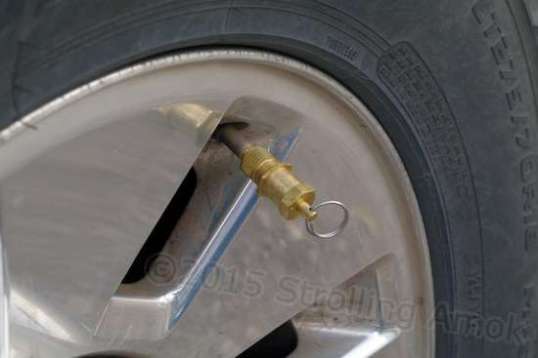
This is a Coyote automatic tire deflator, which does the same thing a puncture does, but without a repair being needed.

This is a Coyote automatic tire deflator, which does the same thing a puncture does, but without a repair being needed. 😉

…or vice-versa, when it comes to tire pressure. One could call tire pressure control “the poor man’s winch”, since lowering tire pressure tends to elongate its contact patch or footprint on the ground. That increase in gripping surface area increases traction on difficult surfaces. Airing down tires in off-road situations is old hat to 4WD enthusiasts, but new to me. It is considered at least as effective as jamming traction boards under the tires, if not more so.

I normally wouldn’t consider it because of its drawbacks:

  1. While you’re airing down or pumping tires back up, you can be sitting beside the road for considerable periods of time.
  2. If you hit a perfect patch of ground for making time in the middle of badness, you cannot pick up the pace on it to gain time – going too fast on a deflated tire can cause overheat and handling issues.
  3. Heavy vehicles on high-pressure tires benefit less from lowering pressures – but do still benefit.
  4. Play Baja Racer, and the doughball handling can put you in a ditch or over an embankment, pronto.
  5. Go too far with lowering pressure, and you can unseat the tire bead, effectively dismounting the tire.
  6. There is a risk on rocky ground of compressing a sidewall enough to pinch it, resulting in damage or puncture.
  7. Overall, operating a vehicle on underinflated tires is a direct trade: increased traction in trade for increased odds of tire failure or vehicle mishap.

I have to admit, I’ll occasionally be lowering my tire pressures not to conquer new trails, but as a last desperate act when I’ve underestimated a trail’s traction difficulty or roughness. Roughness? Yes, and I’m not talking about climbing over grapefruit-sized rocks. Idling over Read more…

Revenge of the Catch-22

IMGP1983

Per my last post on the topic of solar panels for the Mighty Intrepid/FWC Grandby, I had a decent planned setup with a 100W solar panel at each corner of the roof, each panel being held with a 20.5-inch long ABS adhesive mount fore and aft, for aero and dependability reasons. I figured that would be long enough to catch a couple of structural roof ribs under each one, and apply an abundance of adhesion to hold to the roof securely. The only real limitation was that I could come only so close to the roof edge because of tapering of the roof’s thickness.The panels would be held to the mounts with horizontal screws. The panels might be closer to the start of the taper than I liked, but it seemed promising.

As for using ground panels to add solar power, stowing a solar panel in slides mounted under the Grandby’s bed overhang has been done for awhile. After all, that platform is engineered to carry a heap of weight, being a 7″ or more vertical aluminum extrusion wrapped around the bed perimeter. Plywood forms the mattress platform, and a 20-pound panel hung under it should be no big deal, right? Given that the camper is now installed and that drilling holes from underneath is hit or miss because of its closeness to the truck cab’s roof, I thought about attaching a panel-carrying set of rails underneath, held by 3M VHB (Very High Bond) tape and supplemented toward each end with screws, since drilling there from underneath is not a problem. But what was the facing surface under this platform? There are a few different versions of VHB tape, each tailored for certain surfaces. I emailed Four Wheel Campers to ask.

This is what holds the bed platform, so there's no concern about hanging some weight under it - as long as it's done properly.

This is what holds the bed platform, so there’s no concern about hanging some weight under it – as long as it’s done properly.

What I promptly got back was a reply saying, “If you could please call us at ___-___-____, we can discuss a number of issues at the same time and wrap this up for you.” Say what? I’d expected Read more…

Roof Lift Test

Two 100W Renogy solar panels taped to the Intrepid's roof.

Two 100W Renogy solar panels taped to the Intrepid’s roof.

After wrestling with semi-flexible panels vs framed conventional ones, plus a myriad of ways to mount semi-flexible panels to avoid heat and vibration-related failure, it began to sink in that it was really going to boil down to a quasi-lifestyle choice.

I’ve been leaning heavily toward heaps of reliable electrical power with minimal inconvenience, which translates to using some some 600 watts-worth of lightweight solar panels on the Grandby’s roof. Find a campsite, raise the roof, and voila, you’re camping! What could be better? Then I found that semi-flexible panel technology is currently in a bit of a crisis because Read more…

A Little Camper Humor

IMGP1947

There are few darker subjects than terrorism, which is acting out rage against innocents because you cannot or will not act it out against what actually inspires it. It’s beating up your neighbor’s kid and proudly running away, when you know you don’t stand the wisp of a chance against your neighbor himself. It’s passive-aggressive behavior – an avoidance of direct confrontation – on steroids. It’s a weird combination of murderous anger, helplessness and hopelessness. It is a psyche inspired by bloodshed and violence, fired by a perception of injustice that seemingly can only be repaid with more injustice. It can be a contribution to the betterment of mankind gone horribly askew, but in most cases, is simply a way to earn a living that feeds one’s love of hate. The psychopathic serial killer, utterly devoid of empathy, is the amateur hobbyist version, while the terrorist is one turned pro. Rallying under banners of religion or politics or activism is mere window dressing, an attempt to Read more…

Post Navigation