Strolling Amok

Pops goes on tour.

When a Photograph Leads The Way

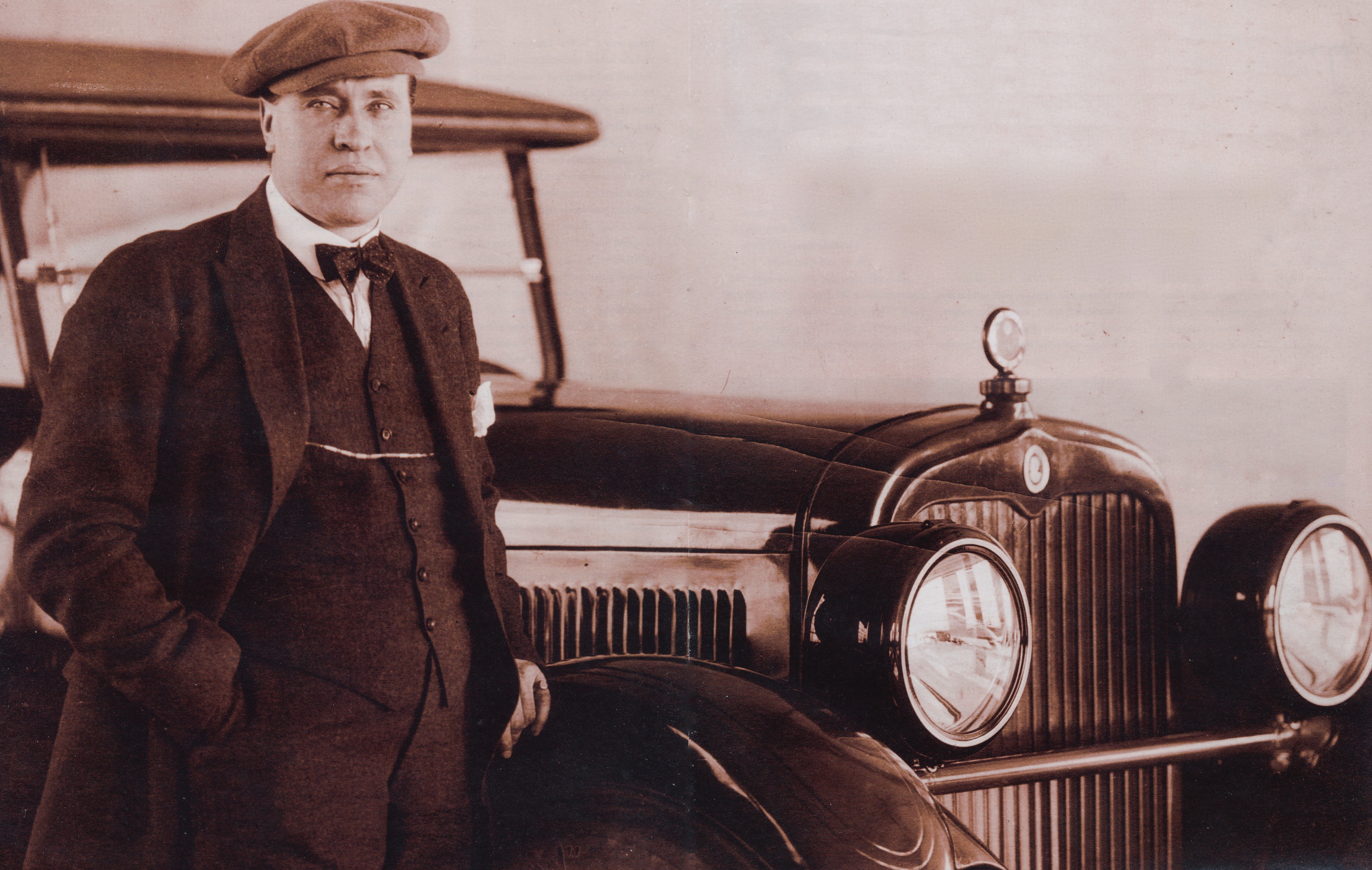
D. McCall White, prominent automotive engineer, circa 1920. (The limitations of the photographic film most widely used at this time included an inability to capture blue eyes well.)

D. McCall White, prominent automotive engineer, in a marketing shot for his new Lafayette automobile for 1920. Clicking on the picture will allow view of a larger image. (The limitations of the photographic film most widely used at this time included an inability to capture blue eyes well.)

While I anticipated being carved up like a hapless captive at a Mayan religious offering last summer, I found the above photograph heading up an article in Traces, a magazine published by the Indiana Historical Society. They culled it from the photographic collection of one Robert Hamilton Scrogin, who was the principle driver of The Hoosier Motorist, a publication of the Hoosier Motor Club. Scrogins’ name was somewhere on that publication’s masthead from before 1919 to 1952. At that time, the rag served up club news, hotel and garage directories, trade news and travel articles.

Traces notes that the Hoosier Club’s origins evolved from a group that called themselves the Flat Tire Club, a collection of “automobile enthusiasts” in Indianapolis. This was an apt club name in that era, since the club formed in 1902, when the horseless carriage was an adventurous hobby for members of the upper class. (In those days, wealth alone didn’t cut it. You had to be considered to be of good breeding, the standards for which were judged by those of…good breeding.) 1902 was a bit of a milestone year for horseless carriages. Ransom E. Olds was the first to build his almost-affordable and very successful Oldsmobile Runabout on an assembly line, no doubt noticed by Henry Ford, who was still struggling unsuccessfully to build and market more upscale vehicles. Prior to that, these conveyances were built one at a time, on one spot on the floor that was surrounded by parts bins. It might be rolled closer to other bins along the way, but that was about it. This earlier method was hardly crude, since the market for automobiles was exclusive to Read more…

Trip Routing


1455971939

This post is definitely more about describing how I work out where to go and where to stop than it is about how you should do so. There is a right way to do things, and then there’s my way. I’m now seriously behind in routing my trip for the upcoming commute/touring season of seven or so months, but that won’t stop me from delaying that task further with this post. Procrastination comes in many forms and with many faces.

Assuming – and that’s a big, pending assumption – that the local medicos do not seriously interfere with my departure schedule or make it necessary to closely monitor dosage results in a way that is incompatible with living on the road, I should be able to clear out of here somewhere in the last half of March, when the temperatures ramp up.

The primary goals are just two: get to Illinois in time to plague family and show up for pre-scheduled annual appointments in that area, and hunt for cooler high-altitude air along the way, at least until the true long-distance commute begins. Secondary goals are to visit the Pima Air & Space Museum in Tucson, and then steer counter-productively back northwest to Prescott to see about installing rear air lifts on the Mighty Furdster. Then, according to plan, I hope to attend the Overland Expo West once again this year, not so much because Read more…

Politics as Theater

My daughter-in-law recently posted the video at the very bottom of this post on her Facebook page, which surprised me – but shouldn’t have. She is a thoughtful person who supported Progressive Bernie Sanders in his bid for the Democratic nomination, and she justifiably felt betrayed and outraged when Hillary Clinton conspired with the media to engineer him out of her way in a move that would have made Richard Nixon beam with pride. Then to try to bring the disaffected back into the herd, Hillary confidently assured them that her pick for VP was a True Progressive, which I was surprised didn’t make her nose grow to yardstick proportions. To ensure her success, the press understandably avoided checking this claim or bringing up any contradictions it presented.

What caught my attention in the first wave of protests in DC and in Portlandia was that Read more…

Gags, Humor, and Solar Power

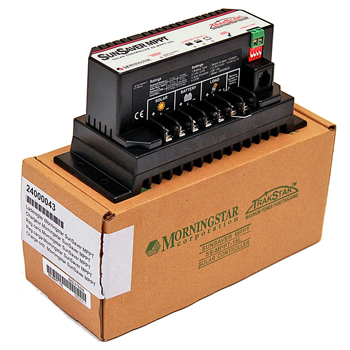
The Morningstar Sunsaver MPPT.

The Morningstar Sunsaver MPPT.

I recently managed to replace the misbehaving Outback SmartHarvest 20A MPPT solar charge controller with a proper Morningstar controller, and now all is right with the world. The Outback was exceptionally naughty right out of the box, and its replacement was no better. The USA office of Outback appeared to be manned only with sales types and customer service reps, with no technical staff on board. The sole solution seemed to be trying another unit. So I did, but opted for the Sunsaver. Since I could not in good conscience sell or even give the SmartHarvest away, it is now residing in the local landfill, where it belongs.

With Morningstar’s remote temperature sender attached to one of my batteries, the Sunsaver now operates in tandem with their TriStar MPPT 45A. The Tristar handles everything coming in from the 360W roof panels, while the Sunsaver serves to feed power in from the 200W ground panels via the external rear wall plug that comes standard with the Four Wheel camper. (A simple internal wiring harness change was needed to feed both of these units to the same battery pack for my installation.) Four Wheel uses the less expensive Read more…

The Corvette Returns

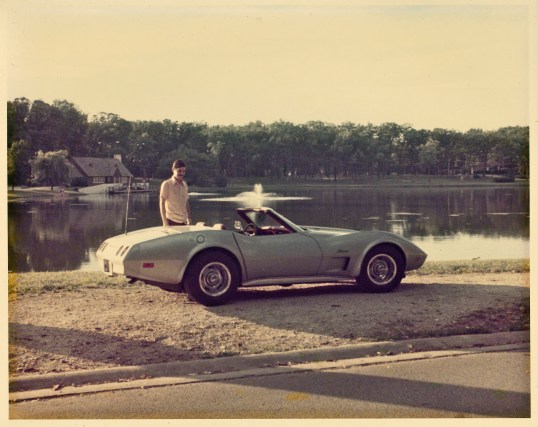
Oh, the adoration just blooms in this 1974 photo.

Oh, the adoration just blooms in this 1974 photo. “I can’t believe I OWN this car!!!”

Awhile back, I wrote a post about the unhappy days I had with my special-ordered 1974 Corvette Sting Ray. It was a mix of wonderment and poor labor practices all rolled into one. It was the last of the all-fiberglass bodied ‘Vettes, the last of the 454 V8s, and the next to last year for convertibles (of that era). It was one of the last Corvettes to come off the 1974 production line. You can read about its checkered past in Listening to the Inner Idiot. I loved that car, and also loved getting rid of it in 1976.

Turns out that the “poor bastard” who then bought that car recently contacted me, not to curse me but to Read more…

Traveling at Warping Speed

Fascinating, no? No. But it will help in understanding this post.

Fascinating, no? Ahhh…No. But it will help in understanding this post.

I escaped from my local Ford dealer the day the other day, but sans shirt. The brakes had been acting up for months, a little at first and then a lot. Now, at 90K miles, they were grabbing at one or more spots as the wheels rotated, with too much stopping power alternating with too little. Pretty jerky, though they could still do a firm stop when necessary. But, it was to the point where the rapid vibrations needed to go away. There was no pulsing at the brake pedal, and no wobbling of the steering wheel, but the Mighty Furd is pretty dead in this regard. Feedback is not its strong suit. I’d recently had the wheel lugs reset to spec, using a torque wrench, since I couldn’t break them loose with a star wrench in order to be able to change a tire. Many repair places simply jam them on hard with a pneumatic driver which, at least with drum brakes, can warp the drum and cause the same behavior. It was worth a try. No soap, though. It was just as bad afterward.

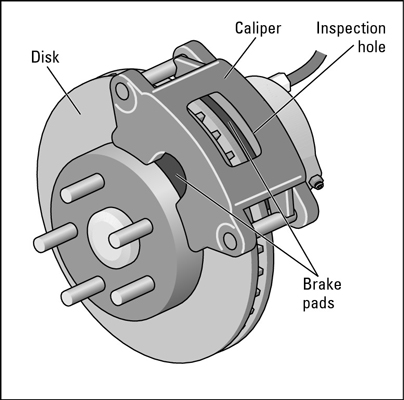
I was hoping that the rotors (disks in the above illustration) were warped and could be machined back to a nice, flat shape. No soap on that, either. The dealership vowed that there wasn’t enough rotor thickness left to avoid going below spec on the minimum thickness allowed. As measured, the runout (disk wobbling) was bad, preventing any meaningful correction. I needed four new ones, which cost a pretty penny indeed, and I had them change out the brake fluid as well, which looked unhealthily dark. The pads, still the originals, were fine, which surprised me. Brakes have not been a trouble-free area for M. Furd. I’d had to have the rear calipers replaced quite some time ago due to freezing up and staying engaged, the result of letting the thing sit for weeks at a time over one winter. That promotes corrosion, which jams parts up and the brakes/wheels get pretty hot. Today, I was hoping that the cashier would not notice the tear stains on my cheeks as I swiped my overheated credit card.

What had happened? I wanted to figure that out in order to avoid a repeat at 180K miles. I was stumped, because my sporty car driving days are long gone, and I now drive like an old man in order to keep the bucket rolling. Overheating should not be an issue in this case. I did some research, and found that disk brakes don’t warp, so my old school thinking was out. Hopefully, the runout on the new rotors is better than the originals. Turns out that for the Super Duty, letting it sit for weeks, as I did in its early life over winter as well as when boondocking with the Defiant TT, doesn’t just rust the brake pads into the calipers. It promotes corrosion on the rotor surfaces except where the pads are sitting. Then it more recently sat in Indy over the humid summer months, which may have finished them off. What you eventually get is a rotor with uneven friction surfaces, which comes out as what I had. It’s possible to catch it way early by swapping in semi-metallic pads at the first hint of grabbing, but really, not letting it sit idle for more than a week, and braking a little more aggressively may help me avoid this kind of Service Dept trauma quite so soon. I’d rather be replacing pads than rotors.

At this particular dealership, the sales people are required to chase down and chaperone anyone outside on the property. Doesn’t matter if you are “just looking” or are waiting hours and hours for your car in Service. They cannot leave your side, just in case you have a question or get a sudden, impulsive urge to buy a car right then and there. Their manager beats them soundly if they don’t. For Service customers facing trauma, maybe it’s also to keep you from wandering across the lot to the Chevy dealer next door, to the west. The Toyota dealer to the east is owned by the same guy as where I was at, so they probably don’t care so much when you go out that door. It’s kind of a forced intimacy, and the youngish salesman who followed me out sized me up and asked tentatively, “I…don’t suppose you’re thinking about replacing your truck.” That was a good guess on his part. I wasn’t. I don’t particularly look like an impulse buyer, nor do I look like an elderly version of a player. I don’t look like I have much dough either, truth be told. Short of a major engine failure or the impending signs of doom, the Mighty Furd shall retain the high honor of serving me until the day that it’s better off being dragged out and unceremoniously shot. But its memory shall live on, both in fact and in legend. Oh yes. So, we talked about how great it is to retire and tour the country most of the year, then winter in an RV park in Yuma. Tour here and there. Everywhere. He left after awhile. I couldn’t tell if he was more bored or depressed.

Brilliance Gone Bad

Notice the rust along the dark slats. This was in use for 9 months.

Notice the rust along the dark slats. This was in use for 9 months.

Last March, I departed Wellton, Arizona with what I hoped was a practical way to keep sharp kitchen knives protected, but handy. There are no reasonable (or safe) wall options for magnetic bars in the Four Wheel (unless you consider installation to the inside of a cabinet door safe), and no storage space for massive butcher block sheaths.

I decided to go with individual blade sheaths, partially in order to keep my options open for which knives to bring along on tour, and which to leave behind in the TT. In the hardware store I once worked at, they offered a knife-sharpening service, and card stock sleeves were used to safely store and handle the finished knives. Oh, that I had a half-dozen of those! There are all sorts of DIY sleeves on the Internet of course, based on Read more…

Traction Jackson

This is from an annual mud bogging event called Mudfest. This careworn 2WD Dodge pickup didn't make it through the trough of gumbo, but it wasn't from lack of trying!

This is from an annual mud bogging event called Mudfest. This careworn 2WD Dodge pickup didn’t make it through the trough of gumbo, but it wasn’t from lack of trying!

[This post is a long one, so you may want to read some and return later. I do not follow the convention of breaking it up into its components, since each of those components interweave with each other to some degree. When the overall topic is finding traction, I’d just as soon publish an article that can serve as a reference, than shotgun the thing just so I can get more web traffic, with the hope that you will consider subsidizing my lunacy. (That comes later, after I’ve established my empire. But don’t worry, I won’t be sending in Brownshirts or anything, for intimidation. They’ll be more like Desert Sage-Shirts, or possibly Taupeshirts… Camo has been SO overdone!) Thus if you have an interest in this traction topic, you can saw your way through. And if you don’t care to infect yourself with it, you won’t be subjected by its different parts for weeks.]

A frequent question I come across among campers in relatively small camping vehicles is “Do I need four-wheel drive?” If you’ve already been camping for awhile and have established the types of places you prefer, the answer is already apparent either way. If you are either an armchair camper planning to get out there someday, or already camp but want to expand the types of places that you drive through or to, the answer can be more elusive.

I’ve been working on this particular topic for well over a year, and the end result is markedly different than the start. I’ve dumped it and started over a couple of times in an attempt to get down to the nitty gritty of it. It started out as a review of all the different types of 4×4 driveline systems as well as tire types and their applicability to different terrains. I found that epic type of presentation to be more overwhelming and boring than helpful. So if you think this article is bad, you should have read its predecessor. While I consider it essential to understand certain basics of how your vehicle reacts Read more…

State of the Intrepid – Scan & Print

Primera Trio with its cover open.

Primera Trio with its cover open.

If there’s one thing I quietly agonized over while setting up the Intrepid, it was what to do about scanning and printing. There have been times when I’ve needed to receive PDF forms which can’t be edited on the computer, so they must be printed and filled out by hand (and perhaps signed) and then either be mailed, or scanned and emailed back. These tend to center around either medical forms, or such things as fishing licenses, which then need to be printed out and carried with me. This can be a problem in the boonies. The vexing thing is that printing and/or scanning isn’t a frequent thing, so once you figure it’s worth the money and all-important storage space, then you need to decide whether you really need both capabilities, and whether you really need to be able to handle letter-size sheets.

Naturally, I researched the usual compact printer solutions. They tended to be rather large, and my available space to stow them is very limited. Adding in the need for scanning complicated this further. In my experience, inkjet printers don’t do well with inactivity – the cartridges dry up and go gimpy, then it’s a battle with a wet paper towel. I looked at thermal transfer, dye-sublimation (sub dye) and laser printers as alternatives, and couldn’t Read more…

Moments of Quiet Deflection

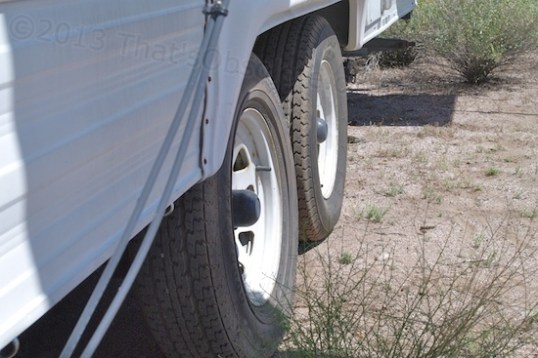
Living a carefree life may include a few contradictions, or at least a little irony.

Living a carefree life may include a few contradictions, or at least a little irony.

The above photo was taken in late 2012 in Quartzsite, Arizona, on the Defiant’s maiden voyage, when I first hit the road. One of the trailer’s wheel bearings went rogue. Five months later, another wheel bearing went away. But as business gurus like to chant, there are no problems, only opportunities. It’s generally good to keep a broad shovel handy when you take advice from business gurus, just as from lifestyle gurus. but their upbeat and motivational phrases and quotes are intended to help us find the little nugget of gold within the pile of simplistic bovine waste matter.

There are opportunities to learn within mishaps and misfortune, miserable or confusing as the experiences might be. Like many other folks, I’ve had my fair share. I’ve had competent counselors throw up their hands at my various situations along my own way through life’s trevails, with one friend declaring with astonishment that I was the “unluckiest” soul he’d ever come across. But I discovered that to a hearty degree, we often make our own luck by our unfortunate decisions, which then channel circumstances that become likely to follow in their wake. I’ve naively or unknowingly signed up for many of mine, but the plus point is that with recognition, comes wisdom. Wisdom is like Applied Knowledge, while knowledge consists of mere lessons still waiting to be learned. Bend enough nails or hit yourself with a hammer often enough, and you may eventually learn to change your approach to handling one.

I’ve recently been looking through thousands of photos in order to pick out a few of the more remarkable ones that reflect not this year’s abbreviated travels, but a sampling of the many, many things I’ve seen and experienced over the last four years. That little project quickly became overwhelming, because I could not pick out some and leave others. Too many remarkable sights, and too many notable experiences. And, some opportunities to learn. It seemed duplicative anyway, since nearly all are well covered in earlier posts. Even using the mini-calendar at the bottom right of this page, it’s still an ordeal to saw back in time, but they’re there. So, all you get is this hurriedly-improvised post instead of a look back at 2016 in review. I’m deflecting the issue, since the benefits of hindsight are still percolating in my mind, such as one may choose to define that. Having realizations is not the same as sorting through them and, as a result, adjusting or holding course or priorities. Besides, I have a positive talent for procrastination.

So, I’ll mention the simple thoughts that came to mind when I found the above picture among those much more notable, beautiful, or inspiring. The inconvenience of a disabling wheel bearing failure on my travel trailer, especially at the start of my travels, seemed to epitomize the uncertainties of radically changing one’s lifestyle. It’s painted one way by those trying to promote it, and those benefits are real. But left unmentioned are many of the practical realities. It helps not to dwell on them, but to learn from them, if possible.

So, what of this particular, comparatively minor mishap, stranding though it might be? What was learned, besides the need to keep one’s wallet handy in this new and carefree lifestyle?

  • I learned that I can tell when a trailer’s wheel bearing has disintegrated by two things: the wheel and tire looking off-tilt (no longer vertical), and perhaps dark grease thrown in streaks over the spinning steel wheel. This is caused by severely overheating the grease. You won’t be able to hear the screaming noise typically made by bearings going bad on cars or trucks.
  • I learned that having the bearings greased at an RV shop, as I had done before the start of my adventure, does not reveal overall wheel bearing condition, nor assurances of same by mechanics. Neither does it guarantee competency in the use of the proper selection of grease or wheel bearing adjustment. An ounce of prevention is helpful, but does not always work.
  • I learned that frequently checking the hub temperatures by touch on long trips is helpful to try to “catch” a failing bearing, but that they can also fail within a three-hour window and not be detected in time. How frequent one’s gas and potty stops are, matters.
  • I learned that when wheel bearings go, they go big, and can allow the rather expensive brake hub to quickly be damaged beyond repair, let alone prevent field repairs because the damaged hub might not be able to be removed by mere mortals with hand tools.
  • I learned that removing the wheel on a dual-axle trailer in order to take weight off the blown bearing (for towing) does no good, since the bare hub will merely drag on the pavement. This is the drawback of having what’s called an equalizer to smooth the ride on a dual-axle suspension. Success here would be of limited value anyway, since the remaining healthy tire (and bearing) on that side would be badly overloaded and likely to fail during anything but short, slow trips to a shop.
  • I learned that towing services are not generally equipped to deal with a failed wheel bearing, and so are relegated to towing the trailer as-is over whatever distance it may be to the nearest repair facility, with the bad wheel still under full weight. If the towing distance is significant, this can escalate damage and repair costs significantly.
Deja vu!

Deja vu! Those wheels are supposed to stay parallel to each other.

  • When a second bearing failed just five months later on the short commute to Wickenburg, I learned once again that a complete re-greasing of all bearings will not stave off disaster, and that it may be best to bite the bullet and just go ahead and replace all the wheel bearings on any older trailer (1994) right at the get-go, as a precaution. It may hurt financially, but it’s less than the pain and added costs of dealing with sporadic failures one at a time in the boondocks.
  • I learned that it is best to learn to properly replace, grease and adjust wheel bearings yourself, if possible. Removing, lubing and adjusting is actually a very straightforward task. It’s the arduous difficulty of getting dropped axles on a heavy trailer into the air that poses the challenge. If the jack can’t get under the dropped axle, you’ll be laying in the dust digging holes with putty knives or whatever you can press into service. There must be the working space available to swing the jack’s handle for lift too, which is a challenge in itself. It’s cramped under there, especially with a low trailer. Dropped axles are the kind where the axle connecting the two wheels is bent down to be much lower to the ground than a simple straight axle. This allows the trailer to ride a few inches lower to the ground. That’s good for RV park touring, but bad for off-road boondocking and jacking up wheels to change tires or do hub work. There are gizmos to get around this, related to changing flat tires, but as with anything, not taking on an inherent drawback is the better approach. Fortunately for you, dropped axles are rare these days, but if you buy an older trailer, take a look underneath. You want straight axles. Seriously.
  • I learned that the lifting power rating of jacks does not equate to real-world use. Scissors jacks are the worst offenders since, in practice, their rating only applies to the very top of their range of motion. Anywhere below that, and you’ll need to be Godzilla on Jolt Cola laced with crystal meth to rotate the undersized handle. Hydraulic jacks are okay, but unless you buy stronger models than you think are warranted, you may find that poor working space to put body weight on the handle will prevent your putting any power into it. A stronger jack will normally lift more weight with the same handle effort on your part. Again, dropped axles may limit your jack choices: stronger jacks usually can’t go as low as weaker ones. Using a jack set on top of dirt or sand is an issue all by itself. Shifting and tilt are the problem, and it’s fairly easy to end with a bent or deformed jack, if not a dropped trailer. Me, I packed a 2-ton (4,000-pound rated) hydraulic jack to lift one wheel on a 7,000-pound trailer, figuring that all I needed was to be able to lift up 1,750-2,000 pounds max. Result: an expanded vocabulary, and a bent jack.
  • Out in the wastelands especially, not everyone who works on your trailer will be experienced in the nuances of bearing lubrication and adjustment. Same with electricals. You’d think that greasing and adjusting a bearing would be a no-brainer, right? The problem stems from the fact that TT axles are always selected for cost, so they always run very close to their maximum load rating in actual use. That leaves no fat for safety margin, and everything needs to approach perfection if the bearing is to live a reasonably long service life. An insufficient quantity of mixed grease types, with or without a careless adjustment, will introduce enough imperfection to tilt the scales. Repair shops range from customer-sponsored experimentation to rock-solid competency. The challenge is to be able to discern the difference beforehand. Sometimes, there isn’t much choice, and you just have to roll with it. But there’s nothing quite like getting a repair done in a timely way and having no more trouble with it until its natural lifespan is over. My own experience has been that there’s little that’s quite so expensive as a cheap repair on things that matter. Your mileage may vary.

So ends my learning curve for today! What’s your story?

Post Navigation