Strolling Amok

Pops goes on tour.

Archive for the category “Mod Squad”

All Stop!

Looks like I'll be starting over on solar!

Looks like I’ll be starting over on solar!

I was preparing to order semi-flexible 100W solar panels from Windy Nation early this morning, the same panels that Renogy offers. Six of ’em weigh about 25 pounds, versus three of the 195W panels from the Defiant that weigh 129 pounds to get the same wattage total. The Intrepid’s roof lift struts help a lot, but not that much!

Then I came across a post about how the cells on semi-flexible panels tend to cup (distort) on exposure to solar heat (pooling dirt), and that this deterioration is evident after just one year. That made me think about the usual warranty on these, which is just 5 or 10 years, and that’s a lot less than the 25 or 30-year warranty on rigid panels. Instead of glass, the protective coating is transparent plastic. When I then stumbled over a Read more…

Installation Day

A forklift brings the Grandby up toward the truck. While I took this shot, I pretended that I wasn't concerned about the changes in tilt that the driveway presented.

A forklift brings the Grandby up toward the truck. While I took this shot, I pretended that I wasn’t concerned about the changes in tilt that the driveway presented.

Installation day for the Grandby turned out to a unique experience. I got up at 5 AM in order to leave at 6:30 and hopefully arrive at Adventure Trailers by 11 AM. I just assumed that installation would take a couple of hours to drill the truck’s bed for hold-down hardware, and to run wires from the battery back to the camper’s power cord. I actually left at 6:45 and booked it to try to compensate for the time lost on the 4-1/2 hour drive. It’s a technical 4 hours of driving, but between stoplight delays on-route, and fuel and potty stops, it adds up. Thanks largely to my Bank of America credit card throwing a hissy fit due to “unusual activity” caused by my traveling stops here and there, I didn’t arrive at the Prescott dealership until 11:25. When I hadn’t shown up by 11:15, they called just to make sure I wasn’t still asleep in Yuma, but they were not booked such that my delay would cause any issues for them.

For the amount of business they do, their facility is a bit tight, but gets the job done. One look at the lot shows that they also use what they sell.

For the amount of business they do, their facility is a bit tight, but gets the job done. One look at the lot shows that they also use what they sell.

Overland Journal has an office opposite Adventure Trailers’ office. That’s a glossy, high-end photographic rag that covers vehicle travel all over the globe, and the effort that takes limits them to five issues per year. It’s an interesting magazine.

At this point I found that the typical installation takes about 3 hours, which would wound my hopes of visiting a camper in Quartzsite on the way back, but it still appeared somewhat do-able. The Mighty Furd was parked and the hood Read more…

Intrepid Heat

The Mr. Heater Buddy.

The Mr. Heater Buddy, with filter and hose.

When I first started out on this crazy fiasco, the Mr. Heater Buddy I acquired for use in the Defiant quickly became my friend while wintering in Quartzsite, Arizona, and it still does sole duty. That’s mainly because the Defiant’s built-in furnace has a faulty overheat sensor that I’m loathe to have fixed. That’s because vented furnaces are relatively inefficient, using more propane than unvented systems, plus their tendency to burn through batteries if left on overnight. Many a new camper has discovered this in the morning, when they awaken to find that the furnace has killed not only their coach battery, but their tow vehicle’s starter battery as well, thanks to their dealer not mentioning that a battery isolator would be a good thing to install. That little adventure is due to the power draw of the furnace’s fan, which on heartier systems must be big enough to push plenty of air through an abundance of ductwork. On the Defiant, the furnace fan also replicates the aural ambiance of the deck of an aircraft carrier, and its old-school “analog” thermostat is a bit too sloppy for holding a consistent temperature.

The Mr. Heater Buddy is the middle-sized model of quasi-ceramic radiant heater, able to crank out either 4,000 or 8,000 BTUs. It can heat the Defiant’s 200-square-foot interior in a shirtsleeve manner on its high setting, down to a windy 30 degrees outside. Its low setting can generally pump interior temps at least 20-25 degrees over whatever it is outside, depending on wind or rain. Being a radiant heater, it sometimes helps to plug in a fan to get its heat distributed better throughout the long trailer. It thoroughly bakes whatever is directly in front of it, but as a warm-air device, it’s wanting. But hey, the price is right, and it’s efficient.

So naturally, when the decision of how to heat the new Four Wheel Grandby A.K.A. Intrepid came up, my first thought was to Read more…

The Mighty Furd Returns

Quick! Take a picture while they're still clean!

Quick! Take a picture while they’re still clean!

Today was a painful day on a couple of counts, but the Mighty Furd is now mechanically ready to handle the future Intrepid truck camper. The bed has yet to be cleared, but something stood out recently which impressed upon me that it was time to replace the original shock absorbers, which have crossed over the 80K-mile mark. This is normally easy to diagnose on a softly-sprung vehicle, but it gets progressively more difficult as spring rates go up.

I’d long ago noticed that the rear axle was twisting under power, a trait called “axle hop”. That’s when you apply power on a poor-traction surface, and the rear axle immediately begins jumping around, shaking the rear of the vehicle. That is a trait of leaf spring suspensions that’s tough on the rear U-joint, but I’ve lived with it for quite awhile, being careful to shift into 4WD-High as soon as it began. As originally delivered, no such trait existed, the axle staying steady as a rock. In fact, given the engine’s bottom-end torque, the only way to tell that you didn’t have traction was that the truck was not moving as quickly as it should for a given throttle setting. With one shock mounted in front of the axle and the other behind, such shenanigans are prevented.

The other tell-tale trait stood out with new vigor when I eased slowly over a speed bump at a border crossing on my way to Prescott to see the new Granby. I’d noticed that the front end kept bouncing a few times some 20,000 miles ago, but this recent event was positively embarrassing. The considerable weight penalty of the diesel engine exaggerates it, there for all to see. Is it possible to be shamed into new shocks? Time to make an appointment.

This was driven home on the winding pavement along route 89 just short of Prescott, which is sports car territory. On this twisty patch of asphalt, the Ford’s springs are too stiff to allow much lean, but the sensation of rubbing all the shoulder rubber off the front tires is there. The tall, squirmy tread on the Coopers certainly doesn’t help any here, but things just weren’t right for such a foray.

I’ve driven low-speed autocross in my misspent youth, and this section of 89 was somewhat similar. There was a certain rhythm that the pavement wanted, kind of a smooth touch of brake, dive in, find the apex within the constraints of one lane, and throttle briskly out of the exit to prep for the next turn. One might reason that, hey, a tall, heavy 4WD pickup truck is no sports car, but as delivered, the Mighty Furd was (astoundingly) the full equal of a then-new Mazda RX8 quasi-sports car I had, at least for pulling steady-state G’s. And that had sticky tires. The Mazda’s weight let itself be known at the same speed as the Super Duty, and the latter still had just a little more suds left. I kid you not. Sure, the physics make it impossible, but the speedo doesn’t lie.

So here I was on 89 with a nice couple in some kind of nondescript Toyota sedan in back of me. It’s not like I was going to try to lose him, but simply hold my end up so that the end of the thing could eventually come calling. It’s a respectability thing. You don’t want to be the slowpoke creeping along in the water wagon, but the Ford wasn’t having it. Goosing the throttle and dabbing the brakes went okay – I even chugged away on some of the uphill sections, but those long turns were excruciating. I was thankful to come upon a widened passing section so he could go on about his business. Last straw. I wasn’t heartened by some clown in a clapped-out Toyota truck-with-cap lurching around a turn headed in the opposite direction. He was doing the TV version of Kojak, well off the proper line and very nearly skidding over into my lane as he did his impression of driving fast. The goal is to be brisk and competent, not threatening other traffic.

The truck was struggling, and loading 1,500 pounds of aluminum into the bed wasn’t going to help. Time for shocks all around. That was finally accomplished today, and in 1972 dollars, the cost was a bit traumatic. I chose old-school shocks that are stiff and stay that way, as opposed to the more sophisticated (and more expensive) sensor-type shocks that try to go limp on smooth roads, and then firm up on bigger bumps. I want control, not a smooth ride. That can’t happen with such stiff springs, anyhow. Once they removed the defibrillator paddles and I hit the road, I found the end result to be a relief. She’s back to normal, such as you may choose to define that.
Oops.

Oops.

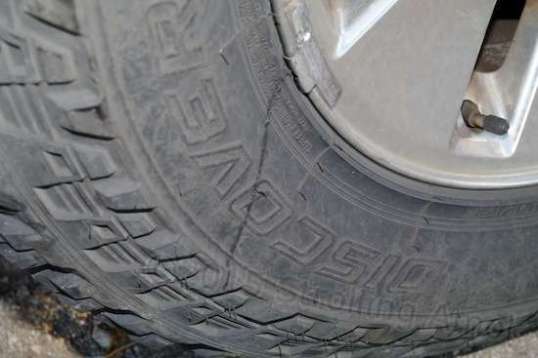
A problem I spotted on arriving home is a concern. I’d gone to the local LTVA camping area to visit, made a tight turn to get on the paved road, and found that a metal sawhorse was hidden under my passenger window. Never saw it as I idled around almost 150 degrees at full lock. It flopped over, I noted the scratch in the paint in the door (since patched), and set the thing back up again. Back at the ranch, I noticed a slice in the sidewall of the right rear tire. It’s down to the cords in some spots, so now I’m ruminating on the most appropriate all-weather substance to seal it off again. It’s so dry here that I have a little time, and if I can seal off the cords from air in a timely way, I won’t have to worry about rust or rot of the cords. There’s still heaps of tread left, so making a game try of it can prevent considerable heartache later. I know what you’re thinkin’, Virginia: duct tape, and I even have some in black! I’m gonna keep looking though. Might call the tire dealer tomorrow. He might have an opinion on that black goop they use around patching plugs.

[Update: a local tire dealer who specializes in retreads and vulcanizing for the local ag folk took a look at it and said, “Nope, don’t worry about it. It’s not down to the cords. That just a surface rubber cut. Not a problem. Doesn’t make any difference.” That simplifies my life a bit! I was a bit confused when I pulled in, as they had a ton of people at picnic tables under a huge permanent canopy, and wandering around masses of pickups scattered all over. Piles of BBQ’d meats, the works. It was customer appreciation day. They know how to do it right. My son does a different form of the same thing for his business, so maybe he’s onto something there.]

The Three-Pound Bag

The wide lens shot tends to exaggerate space. Stand in the back doorway and keel forward, and you'll solidly kiss that tabletop!

The wide lens shot tends to exaggerate space. Stand in the back doorway and keel forward, and you’ll solidly kiss that tabletop!

Truck campers may be among the most space-efficient forms of RV, but once you get into the rough-terrain, compact pop-ups, even amazing efficiency doesn’t make up for not having much space to work with. I mean, the Four Wheel Grandby’s floor from front to back is a half-foot shorter than the Defiant’s width!

As I’ve mentioned earlier, since this pop-up folds down to just 56-1/2 inches to the roof, you can forget about stowing stuff in nonexistent overhead cabinets, or throwing things on top of the bed – the roof folds down to rest right on top of it. What you do with that firm pillow is your business. You can also forget about under-bed storage, where you lever up the mattress edge to reveal a flat but expansive storage tray suitable for clothing and fairly flat items. In the hard-tack world of no-compromises overlanding, where the priority challenges are from the terrain and not from within, creating such an under-bed space would compromise the Four Wheel’s extraordinarily low stowed roof height. Remember that earlier photo of a downtown overpass in Billings, Montana? It works the same for trees and overhanging rock and sometimes, inches make the difference. They especially make a difference when you’ve decided to jack up your truck’s suspension to improve its ground clearance and/or improve its muy macho aura.

Help one thing, hurt another.

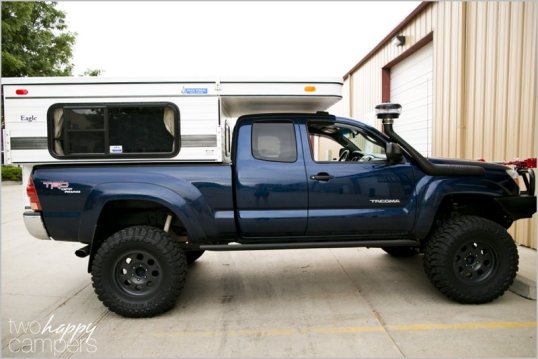
Help one thing, hurt another. Two Happy Campers is a blog I recommend that you read.

In many ways, Four Wheel’s no-nonsense approach to be able to get a durable camping shelter from one obscure point on the terrain map to another is overkill for me. I mean, this is serious hardware, as such campers go. I’m not leading an expedition, goring the doors of the Super Duty on jagged rocks along the edge of a 500-foot drop, or fording rivers, or winching out of foot-deep goo, or filming a mini-documentary of a perilous journey. These campers are not built Read more…

Intrepid Solar Solutions

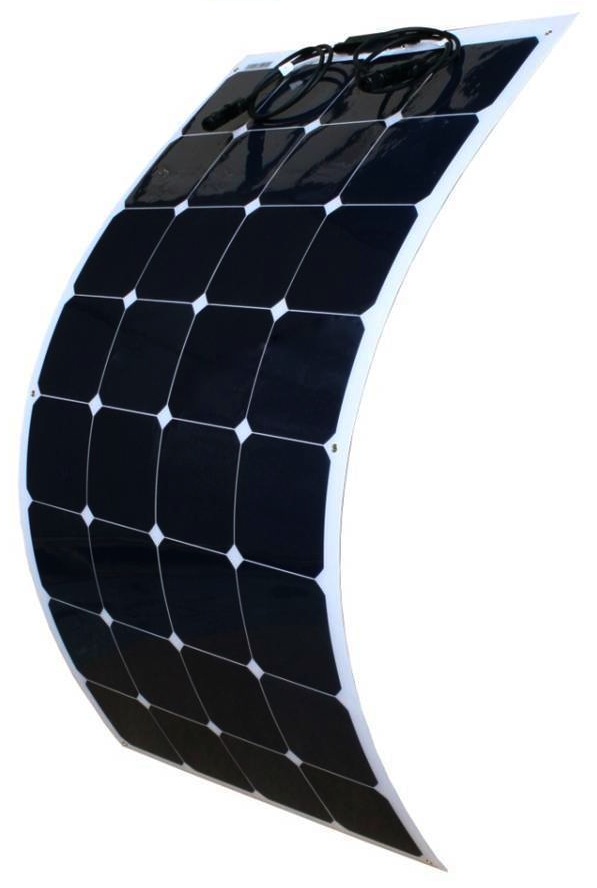
This 100W panel offered by Windy Nation appears to be identical, but comes with additional connectors.

This 100W panel offered by Windy Nation appears to be identical to Renogy’s, but comes with additional connectors. Its 20% efficiency is considered pretty good.

When it comes to angst in planning mods to the Four Wheel Granby, AKA Intrepid, fitting it out for solar comes right behind dealing with its lack of interior space. On the face of it, adding solar to the Granby is unusually easy: it comes prewired for solar whether you want it or not. There’s an SAE socket installed on the roof, and another on the back wall for plugging in ground-based solar panels. Order Four Wheel’s battery option, and you get your choice of one or two 80Ah (amp-hour) AGM batteries, as well as a battery separator to keep you from running down your truck’s starting battery. You can order their solar panels, whether roof-mounted, ground, or both, with a charge controller that comes along. It’s easy, it works well, and you’re rolling the instant you take delivery.

Four Wheel's 100W roof panel is one option that's light enough to cause no issues.

Four Wheel’s 100W roof panel is one option that’s light enough to cause no issues.

Heck, with 240 watts of panels available from the factory powering an optional 160-some Ah of batteries, it’s all anyone could want. I mean, it’s enough to run the compressor fridge and a laptop, as long as weather conditions are decent and you don’t overdo it. And, it’s a “top-heavy” system: there’s enough Read more…

Oh, Snap!

Bugger! I told you these trails are rocky and washboarded! The original fender support bracket snapped.

Bugger! I told you these trails are rocky and washboarded! The original fender support bracket snapped, taking the headlamp with it.

While down in Yuma, Arizona, I was barreling down a rocky trail at speed when the Aurora’s headlamp tried to bail out. Fortunately, it was held by its power cord and I stopped before it could get sucked into anything. With its own bracket bolted to the original front fender bracket, the poor thing spent its life wobbling up and down on each little bump. The fender bracket coating makes it feel like plastic, but it looks and hefts like aluminum at the break. All that constant flexing induced fatigue, and she let go when she’d finally had enough.

Keeping the fender support bracket was simply the easiest thing to do after the front fender itself abandoned ship while the Mighty Furd was carting the Aurora sideways at Read more…

Something Handy to Avoid

Splitter: Bane or Blessing? This is the Roadpro model I recommend.

Splitter: Bane or Blessing? This is the Roadpro model I recommend.

When you have one cigar lighter-type outlet but more than one 12-volt DC device that needs to be run at the same time, a Y-splitter can be a handy solution. Once you insert its plug into your outlet, it then offers a couple of sockets that you can use to advantage. Splitters are inexpensive, and are easy to use.

They are also problem-prone. I’ve had to discard a handful of them when they’ve failed and, as a result, offer here a few tips to use them properly.

The problems stem from two issues. First, cigar lighter connectors are a bad way to Read more…

Solar Demystified

These are 195-watt solar panels, and where you put them is up to you or your rig's limitations.

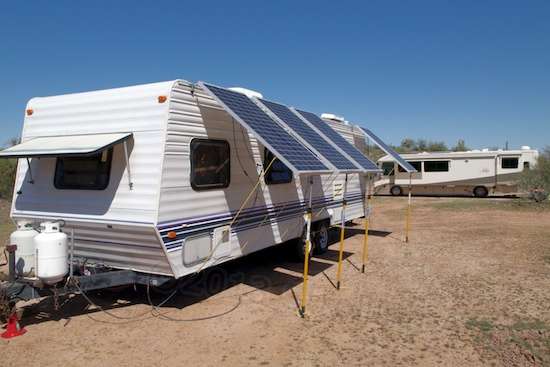
These are 195-watt solar panels, and where you put them is up to you or your rig’s limitations.

I’m no expert on solar systems, but that of course doesn’t stop me from having opinions and expressing my ignorance. Since I’m currently having to engineer a simple solar system for another camper, I thought it timely to write this epistle on what to consider before it’s time to cough up your hard-earned dough.

I know that I’m supposed to break this up into smaller, frequent posts, but I find the loss in continuity disruptive, and kind of a gimmick to boost readership numbers. I have no sponsors, so there’s no point in artificially pumping up visits to impress commercial interests enough to give me money. Yeah, I’d like to have something for you every day just for its own sake, but that ain’t gonna happen. I almost have a life. This blog is based on providing complete and useful information or references, as well as inane trivia, in single packages that don’t force you to wait for the next installment. But at some 7,800 words, it does require tolerance on your part for unending tomes of ignorance. Enjoy.

For the purposes of this article, I’m sticking with simple, almost-affordable systems that you can easily design and build yourself. More costly and sophisticated systems, no. I’m electronically-challenged, and bottom feeder systems are my realm. They are relatively easy to design, install, and wire up.

Where to begin

It’s tempting to assume that the first order of the day is to wonder how many solar panels you’ll need, because that’s what Read more…

Just in Case

The Solartech 10 watt panel is left loose to to keep it potentially efficient no matter what the parking situation is.

The Solartech 10 watt panel is left loose to to keep it potentially efficient no matter what the parking situation is.

Having replaced the Ford’s dual batteries this year (for the first time), their cost was such that I decided to apply a small solar panel and charge controller to keep them topped up while the Ford sits unused for a couple of weeks at a stretch. Not that I can complain about getting seven years off a set, but if I can expand that without losing too much bread in the process, so much the better. Modern vehicles tend to use power when they sit unused, and the drain adds up over time. Starting batteries do not like

Read more…

Post Navigation