Strolling Amok

Pops goes on tour.

Archive for the category “Mod Squad”

Disaster Strikes… Maybe!

Originally posted 10/24/2012

Tuesday, Oct 23rd: Well, today was what I’d refer to as “non-optimal”. Since my past employers preached that there are no problems, but merely opportunities, perhaps I should have titled this post “Opportunity Strikes!”

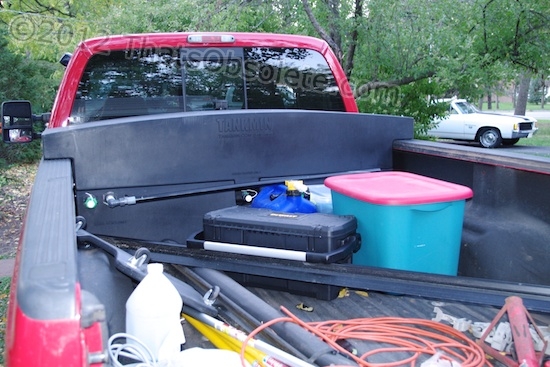
Opportunity one was noticing that the bed floor of the Ol’ Furd was bathed in diesel fuel – not from the tank, but from one of the emergency 5 gallon jugs that’s filled with 4.5 gallons of the stuff. It seems that the cap isn’t really a cap – it’s a holder for the spout, which is supposed to be mounted jutting out rather than tucked inverted inside the cap. How do I now know this? The center of the cap was leaking fuel every time the truck swayed, which is a lot. The center needed to be punched out and the spout run through it to point upward. That isn’t obvious because that center piece blends smoothly on the outside and is carefully engraved with a note to squeeze a safety ratchet out of the way to unscrew it. Lesson learned. Don’t trust engineers. Good thing diesel fuel has a higher ignition point and doesn’t vaporize like gasoline. Also a good thing that everything not impervious to diesel fuel is inside a storage bin that is.

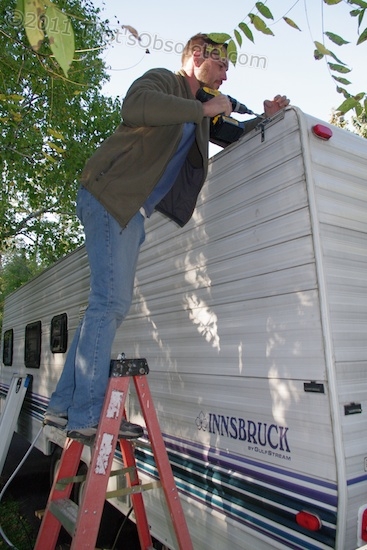
Opportunity two was hanging two solar panels to charge Read more…

Tedium Strikes!

Originally published 10/24/2012

Oh, one more opportunity struck when I went to bed last night. The fuse inside the connector that runs the CPAP directly off of 12 volts blew. Requires a Phillips screwdriver to get access, and those are buried in a toolbox in the truck bed. The fuse? Amp rating unknown, and the manual is kept inside a buried bin. Spare fuses – if I have one this size – are in a storage box in an external-door storage bay. I hooked up my old spare inverter and ran it on AC power. Electrically speaking, this was just not my day.

About 2 AM, I awoke to the sound of some kind of fur-bearing varmint, probably a rabbit, playing with the rear wire cabling that runs from a solar panel to an exterior socket. That’s not good. Varmints tend to like to chew through wire insulation, and that’s never helpful. I put some clothes on and went outside. I’d already gotten the front wiring harness off the ground, but the back harness was not reposition-able until I could re-hang the panel feeding it onto a different set of mounts. Not something that can be done in total darkness – it’s difficult enough in daylight. So, back to bed – until a half-hour later when the rear wires again tapped against the camper. I made some noise, got dressed for the day, went out again for fun, warmed up a little coffee, and took some battery readings.

The house batteries, despite having no load on them that I’m aware of, had dropped from 12.45V to 12.24V. Sounds tiny, but it’s pretty notable. That means that the battery’s state of charge went from 75% to 50%. It means either that there’s some significant parasitic power draw from some device that I’m not aware of, or that one of the two house batteries is failing and is dragging down the healthy one’s voltage from trying to keep it charged. One is new, and the old one had just passed a load test at the RV place. Could have been its last hurrah, because the violence of a load test can finish off a marginal battery. No way to know without methodically pulling out one, putting it on a conventional battery charger until done, letting it sit unprovoked overnight, and then measuring its voltage. Then do the same to the other battery. If one is below spec, replace it. If they both test healthy, then something naughty is pulling power. This kind of check out does take time though, and is best done with a conventional 120V charger on shore power. I’d have to pack up and cross the street to the other gift shop to do that. We’ll see how today goes first.

Fascinating as this was, I fell asleep on the couch. By 6:30 AM, the sun was thinking about coming up, and both controllers were on active charge already. Steady green light = power charge. This is very good news. The panels weren’t producing much more voltage than the batteries had, mind you, but it was enough to kick each controller into gear. The next question is: will the controllers stay on active charge as the panels put out much more juice later? Oh, the suspense!

The answer hours later: yes and no. The single CPAP battery charged normally, more or less, and its charger went into maintenance mode only after a decent battery voltage was reached. The dual house batteries kicked into maintenance way prematurely, and their voltage quickly fell back into problem territory. A call to a different BatteryMinder tech indicated that doing the individual long term battery tests was advised, and that I should disconnect the old battery to see if solar function comes back to normal on the new one, just like the CPAP did. Meanwhile, conventionally charge and test the old battery. If those results don’t shine, it might take a couple of weeks to desulphate before coming back on board, if ever. Time-wise and expense-wise, that doesn’t fit what I can do very well, so I’m going to assume that the new battery is good, conventionally charge it, and try the solar controller with it solo tomorrow morning. Meanwhile, I’ll replace the suspect battery with whatever similar deep cycle battery I can find around here.

With one system up and running, that bodes well for getting number two rolling. I’ve got a fighting chance.

Reminder: there’s no cell data signal at all even in Winslow – this is sent courtesy of a McDonalds restaurant. Don’t expect another post for many days, okay?

Work, Work, Work

A horse trailer, whose driver stopped for some grub at the adjacent restaurant in Texola, OK.

A horse trailer, whose driver stopped for some grub at the adjacent restaurant in Texola, OK.

Originally posted 10/19/2012

Texola has a population of just 36 souls, and the restaurant there makes a meager but steady income from truck drivers a of all kinds. I thought it notable here that the horses in the above photo were saddled, so the trip couldn’t be that long. Next to it was a Bekins moving van specializing in moving show and display hardware. What can I say? I have a low threshold of entertainment.

After taking a vacuum cleaner to the rig, I hung most of the framed pictures. Then I worked on trying to prevent the stored solar panels from shifting during transport and pinching off the passageway between the living room and the front office. To do that, I cut up a 1×2 and made a frame that just fits around the bottom of the stack. In theory, the panels can no longer squirm around enough to choke the passageway off. It’s still tight to get past, but not inconveniently so. I also trimmed off the protruding sanding pad edges that were actually what the panels rested on. In the original installation, the pads not only stuck out well past the aluminum frames, but became what the panels were actually resting on. This made them tippy and torqued the frames a bit in a way that made me think that this might be a bad thing. I have no idea just how much handling abuse these panels can take, since they are designed to mount permanently on a roof and never move, and here I am, banging them around to get them either hung or stowed.

So I used a tile cutter mounted to my trusty  Read more…

Solar to Go

The Enterprise, parked in a residential lot in Indianapolis.

The Enterprise, parked in a residential lot in Indianapolis.

Originally posted 10/15/2011

Electrical power is technically not needed for RV dry camping at all. You can keep fresh water in dispensing jugs, use propane or kerosene heaters, and get light from candles and propane or kerosene lamps.

Electricity only comes into play when you build systems in that are dependent on it. Like most travel trailers, the Innsbruck depends on 12 volt battery power for its water pump for washing up and flushing the toilet. Interior lighting, since converted to LED bulbs, also comes from the camper’s battery. The furnace and water heater use this battery, too. Both use it to auto-ignite their propane heaters, and the furnace needs lots of power for its fan to run for any length of time. If you’re going to use electronic gadgets of any type, power will be needed for them, too.

Tom, installing the hanger eyelet system he designed.

Tom, installing the hanger eyelet system he designed.

Most RVs come with at least one 100Ah battery, which is good for at least one cold night. Some come with two, and many people equip their campers with up to 400Ah-worth of cells. By rationing how they use power, they can stretch the service they get for quite a while. By adding solar panels to the roof, the batteries can be recharged during the day, if the sun is out. This lets folks use their laptops for awhile and do what they need to do. No, you can’t ever run the A/C or the microwave on battery power (except a few fringe wackos), and a toaster or hair dryer is a bad idea, too.

Regardless of how much battery power they decide to carry onboard, the normal configuration practice is to route all solar panels through a single massive solar controller, and pass the charge on to a combined battery pack. If they can afford it, they add a battery monitor to get a true state of charge of the pack – discharging a deep charge battery beyond 50% of its capacity greatly shortens its life. Using just 20% is much better, if that were possible. This type of setup is nearly Read more…

Doing What Can’t Be Done

One bed cover, ready to go.

One bed cover, ready to go.

Originally posted 10/3/2012

The truck bed tonneau cover manufacturer Truxedo and its dealers will tell you that its original Truxedo model cannot be shortened en situ, and that about $520 will get you a special-order cover of another model in a few weeks.

Now the original Truxedo cover is a quality piece, a solid design with very durable materials, and mine cost me about $400-plus four years ago. It can be mounted to the bed by one person in a couple of minutes, using its clamping system. It opens and closes easily, without snaps. Although the tonneau material does not seem to shrink or weather, it can be re-tensioned in another minute or so if needed. For a cheapskate like myself, the Truxedo is one of those few products that you pay substantially more for and don’t regret a penny of it.

But, I hated the thought of ditching my perfect $400 cover to then lay out again for a $500 replacement. A local Truxedo dealer understood my plight and pointed me to Read more…

What a Waste!

Amid the mess is a Tankmin 360 water tank system.

Amid the mess is a Tankmin 360 water tank system.

Originally posted 9/29/2012

Much has been going on with the Enterprise, and I’ll write about each area in separate articles. Step one of major items to be installed was this Tankmin water tank system, consisting of a 70-gallon fresh water tank above a 67-gallon waste water tank. I found a boat cover shop in McHenry, IL with experience in custom automotive work to shorten my existing Truxedo bed cover, and that will happen in a few days.

The Tankmin requires a waste macerater (poo grinder) at the camper tank to pump waste into the lower tank via a special 1″ tube I rigged up, thanks to pplmotorhomes.com and a local Ace Hardware. The freshwater tank is filled by faucet and hose (or gravity fill at the top vent) and drains via hose to gravity fill the camper’s fresh water tank. Thus my total fresh water capacity jumps from Read more…

Post Navigation