Originally posted 4/5/2013
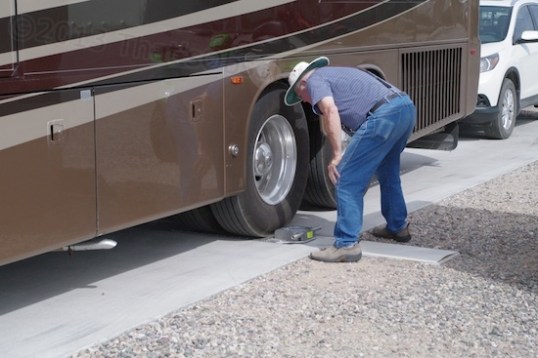
George and an accomplice read scales and note the numbers on a clipboard.
Originally posted 4/5/2013
Had Dickens been at my Smartweigh at the Escapees North Ranch in Congress, Arizona he would have summarized it as, “It was the best of times. It was the worst of times.” Although the Smartweigh is a safety-oriented number-crunching exercise, with terms like GVWR, GCWR, and GAWR, I’ll try to make the explanation of it as understandable as possible. The Executive Summary: As far as the numbers go, I’m looking good – much better than I thought. The bummer is the remaining three “original” trailer tires themselves, and the weight distributing hitch. Even though I’m not overloading any tires, it would be a real good idea to lose some weight. I’ll show you why.
The Escapees’ Smartweigh system is much better than your typical truck stop scales, which weigh the tow vehicle, the trailer, and then both. All that does is give you a “yes, no, maybe so” result that tells you if the individual units are overweight.

A typical North Ranch street. Wide and paved. Housing ranges from park models to modular to conventional.
For $55 for a truck and trailer weigh-in, the Smartweigh test coughs up individual loads on each tire. Because RVs typically load their tires and suspensions very near their load carrying limits, and do not distribute those loads evenly, it’s common to have an RV weigh in under the maximum limit, and yet be overloading one or more tires. In order to get “worst case” numbers, the RV is supposed to go into the test with all fuel, propane and fresh water tanks full, while all waste tanks are to be empty. This is the normal travel mode.
For the record, the majority of RVs tested so far have overloaded something beyond its limits. That presents a safety problem, sometimes a legal liability problem in case of an accident, and it accounts for many interesting, unplanned road adventures. It’s a fair question to Read more…














 Strolling Amok