Strolling Amok

Pops goes on tour.

Archive for the category “Mod Squad”

The Case of the Failing Fridge

The nerve center of the 1994 Dometic Model 2611 refrigerator freezer.

The nerve center of the 1994 Dometic Model 2611 refrigerator freezer.

I could put it off no longer. I hate doing repairs where the odds of screwing up guarantees additional cost. The Enterprise’s fridge was sporadically shutting down when fueled with propane, and the only signal was a “check” LED light on the control panel. Fail to notice in a timely manner, and your food supply is at risk.

Word on the Web was that the problem was common to Dometic units, with the most common mantra being that any failure of a ground wire or any connections to the board could trigger a shutdown. The purported solution was a replacement board made by Dinosaur Electronics, which was specifically geared toward a double ground connection. I ordered and promptly received one a month ago, but hesitated to get into the actual repair work. But, the time came when I had to step up to the plate, because I’d need to let it run for quite awhile to made sure that this was in fact the fix.

After struggling off and on for an hour to solve the mystery of just how to remove the OEM protective circuit board cover, I finally succeeded. Dinosaur Electronics was careful to provide a schematic of old and new connections along with its installation instructions, but it quickly because apparent that my Dometic board did not fully match the schematic, and was different enough to invite disaster. What to do? It was now about 4 PM.

I went to Dinosaur’s website and clicked on their customer service form to send an e-mail. That merely sent me to a page declaring an internal server error, which means that e-mail was out. What the heck. I dialed the tech help phone number and it was immediately picked up by a gentleman who turned out to be the founder and owner of the company! As he explained, only he would be crazy enough to still be in the office so late on a Saturday. Saturday! I’d lost track of days and had thought maybe it was Friday. This was momentous! But there he was.

I explained my dilemma, assuming that the board I had was some no-name replacement patched in along the way. Not so, he explained. What I actually had was a fairly rare OEM board, now vintage, made before Dometic issued an engineering change that led to the “bad ground” boards that followed. It seems that my board had proven so problematic that Dometic, without publicly acknowledging anything, simply changed the design to one that they felt would work more reliably. It only partially shared connections with the later boards. There were so few of my type of boards left that Dinosaur had not bothered to issue a schematic that included it, but I think I convinced him to get one of his boys to make one up, because he did say that they still got plenty of calls from customers confused about how their old board didn’t match the schematic supplied. They sell a ton of boards, so even a few percent means a lot of calls that could be prevented by one more page of instructions.

This guy basically told me more about my board and the industry than I ever wanted to know, but in the end I had specific point-to-point wiring instructions to replace old with new. There was no excess of wire lengths inside the outside-access compartment, but there was just enough to allow transfer of the connectors one by one. At my hesitant pace, it probably took less than five minutes. I hooked power back up, and nothing smoked or threw sparks. I fired up the fridge, and it seemed to operate okay. Now, several days later, it’s been running like a…well, like a refrigerator. I keep a special thermometer hanging inside the lower compartment, and temps are just as they were before, which is good. I’ll need a couple of weeks of running to feel completely good about the Dinosaur board, but it sure looks good so far! I of course hated the $100 replacement cost, but the greater reliability will have easily paid for itself within a couple of years (in ending prematurely spoiled food). Bon Appetit!

Hittin’ the Skids

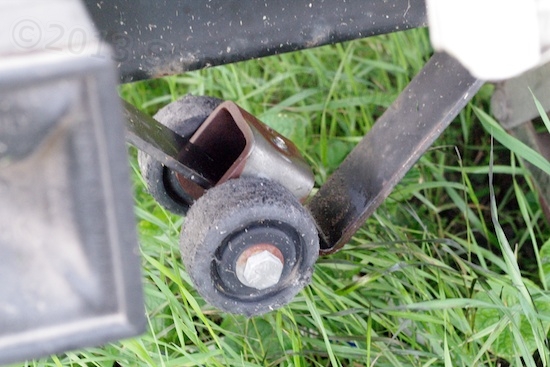
View from the rear: one bolt removed, and the other stripped and locked in place.

View from the rear: one bolt removed, and the other stripped and locked in place.

The skids on the rear of the trailer have been a problem. In use, they have shifted up on the “V” of the angle iron they’re mounted to, allowing the tip of the iron strap to contact the ground directly. That’s tough on the strap, and will soon result in an unusable skid. The cause is that the wheel assemblies were mounted on the rearmost angle of the strap, causing them to shift back and up, out of the way. Given a spindly 3/8″ bolt with a locknut, the bolts bent easily from the side load applied to them.

One bolt was removable, while the other rusted in place and snapped off when torque was applied.

One bolt was removable, while the other rusted in place and snapped off when torque was applied.

A fix was needed. Either that, or use the grinder to take the entire contraption off completely and let the bumper take a beating. As far as a fix was concerned, it was made more difficult in that the pair of bolts on each bracket were badly bent from the sideways force applied to them. Bolts aren’t made for that. With the help of a high-speed grinder, Kroil penetrating oil and Vise-Grips, the bolts were removed. I decided that maybe less bolt-bending would occur if I Read more…

Fun With Awnings

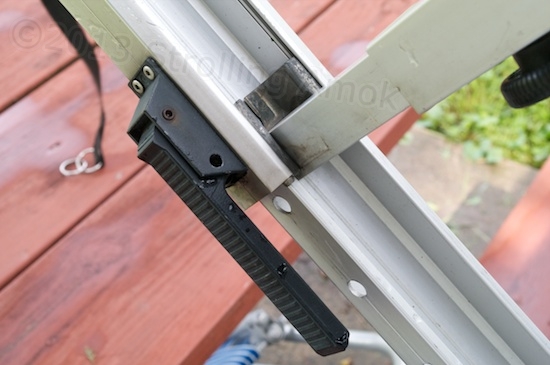
The awning has two of these telescoping arms. Yanking out the handle disengages a pin from a hole, and the arm can be retracted. Easy, yes?

The awning has two of these telescoping arms. Yanking out the handle disengages a pin from a hole, and the arm can be retracted. Easy, yes? The square post coming toward you is just a brace.

Early one recent morning, I awoke to find a large thunderstorm approaching, and I could tell that it would be a windy one. The forecasts here rarely mention potential wind speeds, so I clambered out to retract the awning. Unlike the solar panels, it does react to winds much over 10 MPH. The retraction process is quick and easy: just pull a locking handle on each arm that holds the awning out, and allow each arm to telescope to its shortest length. Then unlock the roller and allow it to move up toward the trailer, gathering the fabric as it goes. It’s a lot like a big window shade. Trouble was, one of the two locking handles failed just then, and that arm stayed extended. The pin that it controlled couldn’t be persuaded to retract with tools, and the handle was riveted on, so it could not be removed. The rain began, and I found that the awning does not slope enough to drain all water, so between the wind and the trapped water, this posed a problem. One of the poles holding up a solar panel was Read more…

Solar of the Absurd

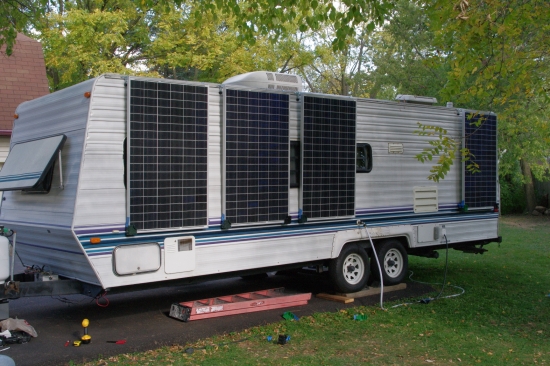
Ummm, aren't solar panels supposed to be mounted on the roof? Normally, yes.

Ummm, aren’t solar panels supposed to be mounted on the roof? Normally, yes.

I receive questions about the Enterprise’s peculiar solar power system, and peculiar it is. One would like to think that my solar system is being presented here for you because it’s unusual, and might give you something to learn or to think about. True enough. It may inspire you to consider unusual options when suddenly confronted by major obstacles. It may also convince you of the real value of both diligence and thoughtful learning. It will also underscore that haste makes waste, and that ignorance can derail even the best laid plans.

My original goal was to quickly acquire an old, mid-sized travel trailer having a certain floorplan that I needed. Then I would slightly modify the interior space, install solar power for full-time boondocking, and hit the road before cold weather set in. I’d never done anything remotely like this, and am not particularly “handy”. Time was exceedingly short, and I’m not above trading away sophistication and elegance for whatever is workable. When a rain cloud is overhead, a tarp and a stick is often better than a pile of arched steel spans, roofing materials, bricks, and bags of mortar.

The Master Plan

Think of my system as “modular”. One solar panel, one solar charge controller, and one battery pack – nothing unusual about that. Each component is closely matched to the other to maximize performance and minimize cost. The only difference is that, to get much more power than it can produce, you don’t then start upsizing the individual components. Instead, you simply add more of these modular solar assemblies to your project, placing them where you need them. I’ll be the first to admit that upsizing is usually the least expensive way to scale up power. A bigger solar panel usually costs less than two smaller ones. A higher capacity charge controller normally costs less than two smaller ones. Same for batteries.

But, I’d stumbled upon a sweet-spot for my purposes: Read more…

On the Level

The offending party.

The offending party.

The Dometic refrigerator/freezer has always been marginal in operation, rolling from too-cold to too-warm at the toss of a coin. The “thermostat” doesn’t hold set temperatures – it only asks for colder or warmer in some generic way. This is aggravated by all these types of fridges having a weak cooling system that takes a long time to overcome placing new, warm items inside, or being able to deal with being lightly loaded. It’s the nature of the beast. This one also shuts down now and then, requiring an alert eye to prevent excessive warming up before restarting it. Fortunately, it has never failed to start right up…so far.

When I stayed overnight at Bluewater Lake State Park, I noticed that the refrigerator was suddenly unable to maintain minimum temperatures, even at full throttle. I attributed it to high winds or bad luck. It improved a little when the winds died off at night. The problem got a little better in transit, and then worse again once I parked in the Cibola National Forest. Watching food spoil while parked miles from the nearest town is not the best.

Now, a failing fridge is not something you want unless Read more…

Power to the People!

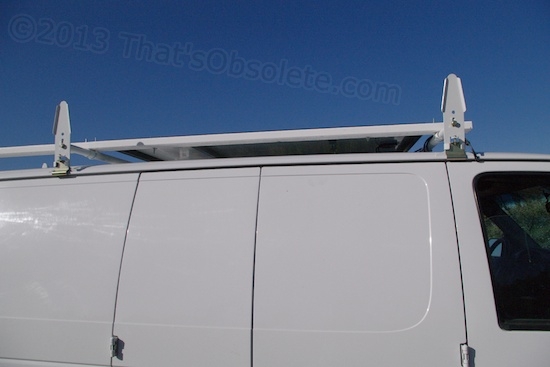
This rack-mounted solar panel is unobtrusive, and the airflow underneath can help aid output by keeping the panel cooler.

This rack-mounted solar panel is unobtrusive, and the airflow underneath can help aid output by keeping the panel cooler.

Originally posted 4/26/2013

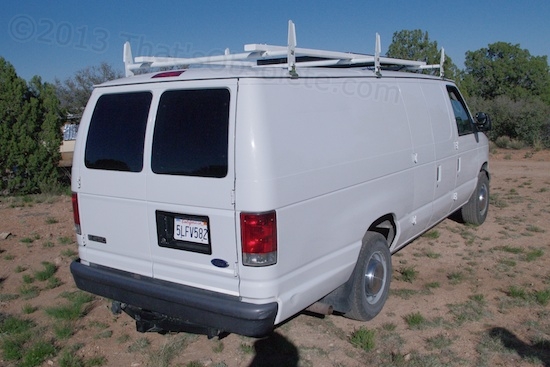
This post is just to let you know how the riff-raff south of the tracks live. Mike is not a newbie, having full-timed off and on for the last few years, But, he has been doing without solar power while living in an ex-construction E-250 van. He’s been drawing power off the van’s starting battery, which isn’t good for it in the long run because they aren’t made for that type of use. He just bit the bullet and stepped up to a 245 watt solar panel and a couple of 6-volt deep cycle AGM batteries that give the system more power than two of my 12-volt AGMs. For a van with much more modest power needs than me, this is a pretty hearty system. Some outfits make 12VDC refrigerators and refrigerator/freezers that look like typical coolers you’d use for a picnic, so getting decent electrical power begins to open up possibilities for food storage and other things that can greatly affect how you live.

Unlike my rig, vans have no problem with either rough terrain or in-town store parking lots.

Unlike my rig, vans have no problem with either rough terrain or in-town store parking lots.

I couldn’t possibly pack myself into a van for more than a couple of months, but these guys seem Read more…

Ahhh, West and Wewaxation at Wast!

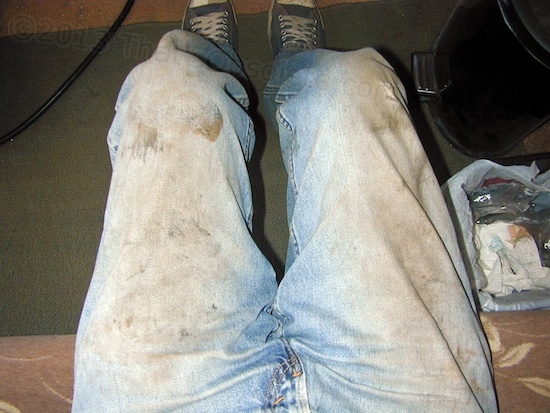
Ready for... Laundry Day, don't you think?

Ready for… Laundry Day, don’t you think?

Originally posted 4/11/2013

Well, the process is over. Pull a wheel and hub. Head into Wickenburg to drop off the hub for bearing removal and replacement, and get the tire dealer to swap the rubber donut for new. When a hub is ready, pick it up and return to install it on the trailer and pull another. Rinse and repeat. It took several days because service on the hubs couldn’t be instant. Total, $844.22 for four tires, three bearing sets with seals, and the labor to pound out the old and pound in the new. Plus, a spare bearing and seal set to carry on the road.

See the label still on the rear tire? I'm done, with about and hour and a half to go before sunset.

See the label still on the rear tire? I’m done, with about and hour and a half to go before sunset.

Just for morbid curiosity, I also pulled the new hub that had been replaced in Quartzsite. Expecting to find an abundance of grease, I found everything clean and dry, with just a whisper of clean grease wetting the tapered rollers. That’s not the usual practice. The mechanic here expressed his preference as, “If a bearing fails that I put in, it’s not going to be for lack of grease. These things heat up.” I slopped more in with my grease gun and a weird stem that is handy for reaching into such areas. So I’ve done all I can do, and it’s now merely a matter of hub touchy-feely and watching for tilted wheels once I hit the road again.

But that won’t be right away. I can stay here for up to another week if I like, and I’ve been concentrating on getting the repairs done. I’ll likely do laundry and food shop soon, as well as tour the area and walk around Wickenburg, which is a peculiar little town. Much of it is modern and relatively upscale, and some spots here and there are kind of eclectic Old West in their own way. But, I have yet to climb out of the Furd, apart from the two repair places involved. I can say that the people I’ve dealt with as well as those wandering in for one reason or another are “un-urban”. Low key, open, and they’ll just wander over  Read more…

Plan the Work…

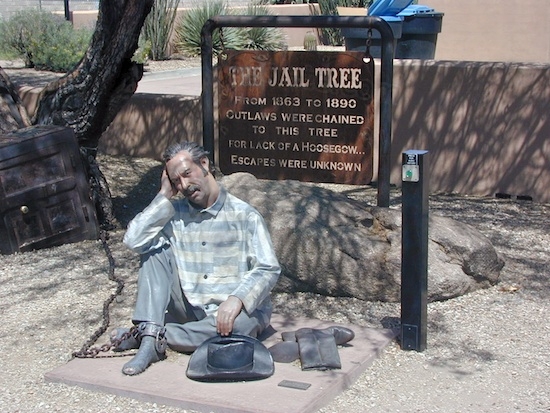
"The Jail Tree - From 1863 to 1890 outlaws were chained to this tree for lack of a hoosegow... escapes were unknown"

“The Jail Tree – From 1863 to 1890 outlaws were chained to this tree for lack of a hoosegow… escapes were unknown”

Originally posted 4/8/2013

Checking the weather forecast for today shows a cloudy and high wind day, with wind gusts up to 50 MPH. Much of that wind will be from the south, directly onto the driver’s side of the trailer. That means I had better angle the solar panels down and strap them, as well as anchor the wheel chocks in case the trailer itself is tempted to shift. Done. This simple procedure took about an hour this morning, and unstrapping later will take more than that because of the poor quality of the cheapo Chinese ratchet strap mechanisms. The straps themselves are also wearing because of fluttering in the wind. Time to revise that system, probably with something rope-based.

My “action plan” this week is to get the trailer back up onto its feet and end the ongoing spate of problems with wheel bearings and tires. Since the remaining three old tires are potentially fragile, they must be replaced. With the wheel bearings in doubt, any road crisis involving use of the Axle Crutch would require severely overloading the remaining tire on that side. Doing that to an aged tire already at its load limit would  Read more…

El Cojinete está Muerto

Umm, the hub is not supposed to droop down like that.

Umm, the hub is not supposed to droop down like that.

Originally posted 4/6/2013

The title to this post means The Bearing is Dead. This is the second wheel bearing to disintegrate, this one 115 miles after being lubed and reinstalled. The good news is that the hub did manage to be able to be pulled off after a few hearty yanks, and the complete bearings (less loose tapered rollers) came off with it. That’s far superior to what happened on the last bearing failure. I wasn’t able/willing to pound out the bearing races held inside the hub, and made my way to Wickenburg to find a shop that could apply the necessary brute force. The automotive shop in Wickenburg wasn’t really open, this being Saturday, but people were there so I dropped off the hub and they’ll get to it Monday. I also need to drop off the rest of the bearing parts so they can try to match up what I’ve got.

While in town, I picked up a 2-ton floor jack on sale for $25, a replacement fire extinguisher for the trailer ( the 25-year-old one registered zero on the pressure gauge), a metal file, an abrasive sponge, and some fine grit wet/dry sandpaper. But let me describe how I got to this point, with the trailer wheel up and hub off. I didn’t want to try to hoist the affected wheel with the crappy scissors jack again, so I figured I’d press the F-250’s jack into service. That didn’t turn out  Read more…

Smartweigh: Geekoid Nirvana

Originally posted 4/5/2013

George and an accomplice read scales and note the numbers on a clipboard.

George and an accomplice read scales and note the numbers on a clipboard.

Originally posted 4/5/2013

Had Dickens been at my Smartweigh at the Escapees North Ranch in Congress, Arizona he would have summarized it as, “It was the best of times. It was the worst of times.” Although the Smartweigh is a safety-oriented number-crunching exercise, with terms like GVWR, GCWR, and GAWR, I’ll try to make the explanation of it as understandable as possible. The Executive Summary: As far as the numbers go, I’m looking good – much better than I thought. The bummer is the remaining three “original” trailer tires themselves, and the weight distributing hitch. Even though I’m not overloading any tires, it would be a real good idea to lose some weight. I’ll show you why.

The Escapees’ Smartweigh system is much better than your typical truck stop scales, which weigh the tow vehicle, the trailer, and then both. All that does is give you a “yes, no, maybe so” result that tells you if the individual units are overweight.


A typical North Ranch street. Wide and paved. Housing ranges from park models to modular to conventional.

A typical North Ranch street. Wide and paved. Housing ranges from park models to modular to conventional.

For $55 for a truck and trailer weigh-in, the Smartweigh test coughs up individual loads on each tire. Because RVs typically load their tires and suspensions very near their load carrying limits, and do not distribute those loads evenly, it’s common to have an RV weigh in under the maximum limit, and yet be overloading one or more tires. In order to get “worst case” numbers, the RV is supposed to go into the test with all fuel, propane and fresh water tanks full, while all waste tanks are to be empty. This is the normal travel mode.

For the record, the majority of RVs tested so far have overloaded something beyond its limits. That presents a safety problem, sometimes a legal liability problem in case of an accident, and it accounts for many interesting, unplanned road adventures. It’s a fair question to  Read more…

Post Navigation