Strolling Amok

Pops goes on tour.

Archive for the category “Miscellania”

Ooo! More Junk Mail Friends!

Apparently, I’m more popular than I thought! Witness the following emails I received recently:

“Greetings,
I am Judece Michael Tisioh, writing with due respect, trust and humanity, I got your email address after an extensive on-line search via network power charitable trust for a reliable person. Please exercise a little patience and read through my letter, I feel quite safe dealing with you in this important message, I will really like to have a good understanding with you and i have a special reason why i decided to contact you, I decided to contact you due to the urgency of my situation. I’m writing you from hospital bed, therefore this message is very urgent. I have a donation to make which I will need your assistance to carry it out, I will be 62 years old this coming month, I’m a widow and a government worker for many years here in Ivory Coast. I have sum of $4.9 Million, Four Million Nine Hundred Thousand United States Dollars with my late husband Hon. Michael Tisioh, I want to donate to orphanage homes and Charity organizations through you.
“I have a serious cancer disease and will be going for my third surgical operation, although the doctors had already confirmed that I will only last for few months but I am glad that the lord has kept me safe and guided me to accomplish my desires. I want you to contact my house helper, I have given him the documents of the funds and have directed him to a lawyer that will assist you to change the documents of the fund to your name to enable my bank transfer the fund to you.
Victor Bailly Joshua.
Address: Avenue 16, Wade Ave,
Abidjan 16, Cote d’Ivoire.
Email: vbailly17@gmail.com
He will give you the documents and direction on how to contact the lawyer i contracted to assist you, the lawyer will do everything on your behalf here in Ivory Coast to ensure the success of my fund transfer to you.
This is the favor i want from you after you received the fund under your control.
(1) Give 20% of the money to Victor Bailly, he has been here for me throughout and i promised to support him, therefore you will take him as your child.
(2) Give 60% of the money to charity organizations, orphanage homes e.t.c, on my name so that my wishes will be fulfilled.
(3) The remaining 20% should be for you and others that you may personally wish to assist.
Remain Blessed,
Mrs. Judece Michael Tisioh.

This message has been scanned for viruses and
dangerous content by MailScanner, and is
believed to be clean.”

And the following personal message from one Susan Williams, entitled “Hello Dear”:

“Hi
How are you? I must confess that you’re a nice looking gentle man on your profile.Are you married?, Can we be friends?????
Susan”

The latter is especially engaging because it was marked “To: undisclosed recipients”, which means it was broadcast to a ton of people like myself. You know, guys with that same kind of sensual masculinity that I have. Makes me feel special, because “Susan” knows I’m handsome by the photo of me that is missing from my profile page. Somehow, I have the feeling that any reply will eventually turn to the topic of finances. How is it that my mail program segregated these great opportunities into my junk mail folder?

Sheesh!

Road Locomotives

Once cutting edge technology, these steam tractors are still very impressive accomplishments.

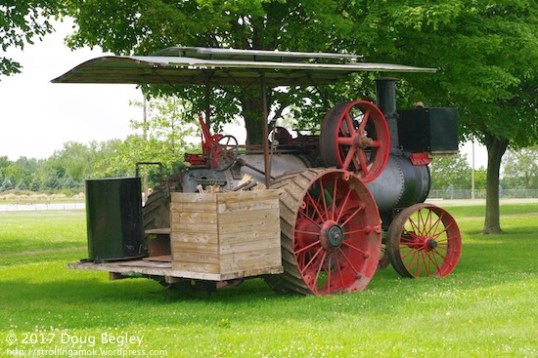
Different weeks here in Butterfield bring different sights. This week, it’s a couple of steam-powered threshing machines that have been moved out of a large shed and parked on the grass. This won’t do the grass much good in the long run, since the prodigious weight on the rear wheels of these things visibly compacts the soil! These two are not the largest I’ve seen, but they are certainly large enough.

Advance Thresher Co., Battle Creek, Michigan. 1881-1917. At their peak, they produced 1,000 annually, along with much more harvesting machinery of various kinds. (The rear platform and boxes on this one are not original.)

They are referred to mainly as steam threshing machines, though the terms traction engines, road locomotives, and tractors are often bandied about. We think of them today as steam tractors, but that connotes plowing as the main function, which is not really accurate. They were actually designed mainly as Read more…

The Butterfield Marauders

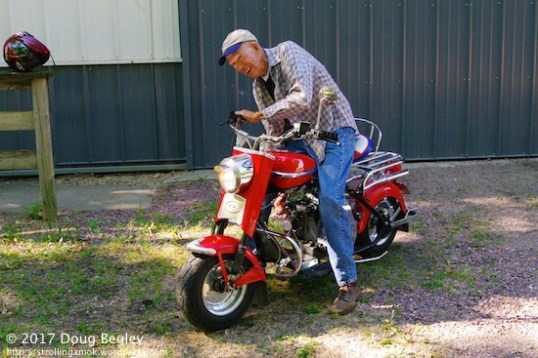
Not having been started for months, this little motorbike sputtered for awhile before it was able to idle.

Out for a walk a couple of weekends ago, I returned to camp to find that a motorcycle gang had moved in. Okay, maybe it was more of a motor scooter gang, and all of their bikes were vintage and very similar. The rider in the photo above told me that his mount was a Hirscheiser, spoken in a tone which assumed that I had heard of it, or at least should have, had I been civilized or at least housebroken. You know, Hirscheiser! Nope. My memory banks coming up dry, I didn’t think to ask for the spelling, and a modest search online didn’t produce anything. Nonetheless, a half-hour later, fifteen riders of the little bikes putted down the road toward downtown, happily looking for trouble.

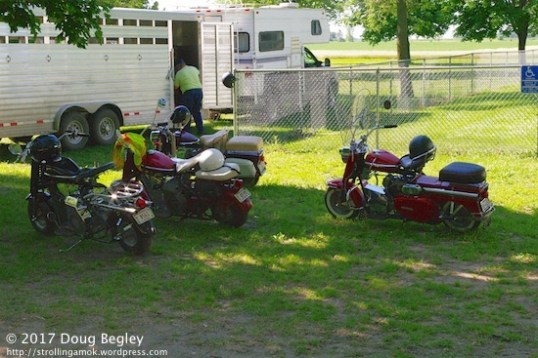
I thought these were all there was, until I later peeked out of the Intrepid to see a stream of them heading toward town.

Nearby were parked two Indian motorcycles, 1946 and 1951 models. The stuff of legend, Indian motorcycles predate Read more…

Last Call for Senior Passes

Grand Canyon

I’ll quote from an Escapees.com emailed notification:

On August 28, 2017, the price of the America the Beautiful – The National Parks and Federal Recreational Lands Senior Pass will increase from $10 to $80. This increase is a result of the Centennial Legislation P.L. 114-289 passed by the US Congress on December 16, 2016 and is the first increase since 1994.

The lifetime Senior Passes provide access to more than 2,000 recreation sites managed by six federal agencies:

  • National Park Service
  • US Fish & Wildlife Service
  • Bureau of Land Management
  • Bureau of Reclamation
  • US Forest Service
  • US Army Corps of Engineers

The passes cover entrance and standard amenity (day-use) recreation fees and provide discounts on some expanded amenity recreation fees. For more details about the pass, visit Changes to the Senior Pass.

To purchase this pass any federal recreation site, including national parks, that charges an entrance or standard amenity (day-use) fee. You can also purchase online or through the mail from USGS; an additional $10 processing fee will be added to the price. Visit the USGS store.Read more…

Much Ado About Nothing

I regularly come across examples of how our perceptions can markedly contrast with reality. That always impresses me, and in the realm of major media, I’ve found that it takes quite a bit of personal digging to negate the filters of bias which tend to permeate their end products. If you want to know what they think about an event or an issue, all you have to do is read or see what they produce. If you want to find out what actually happened or what else is involved within an issue, you’re going to have to do some excavation yourself, elsewhere. You may be one of the those who trusts their news source these days, but Walter Cronkite passed away decades ago, so if you just turn on the news and accept it without question as accurate and balanced, you may find yourself becoming unbalanced. Editorializing does that. Propaganda does that. The difference between them is that editorials are labeled as such. Propaganda is not, yet purports to be a reasonably accurate representation of the true situation.

Straight news reporting and accountability for errors has become an endangered species. Propaganda works. If I listen to Fox News long enough, I find my opinions of facts and issues swinging their way over time. If I switch over to NPR, I find myself going the other way. In the end, we’re stuck with listening to the bias that we prefer, and become unable to understand Read more…

Mr. Picky on Fender Flares

Lifted, big tires, Chevy.

Rant time! Okay, maybe not so much a rant as expressing an opinion parading as a pseudo-fact. Aftermarket fender flares for trucks. They are plastic attachments that emphasize the wheel openings in vehicle fenders. They’re fairly popular as a way to make one’s pickup look like an off-roading titan. They often look good. Sometimes they look bad. Really bad. I’d seen individual samples here and there, but whilst pigging out on a heavy-duty ice cream confection at Whippy Dip in Silver Lake, Michigan (which is not entirely unlike a pilgrimage to Mecca), I saw two pickups parked near each other that illustrated the far ends of the fender flare universe. I was motivated to take photos with my ever-present iPhone.

Now, you may not think that fender flares are worth writing a blog post about, and you’re right. I’ll give you that. It’s decidedly a waste of electrons, especially since half of my readers are of the female persuasion, and I have yet to discern the topic of fender flares when walking by any conversation on the street. But some things just need to be noted, and although this isn’t one of them, I’m writing about it as if it is. Personal quirk.

At any rate, the truck in the above photo has fender flares that work well visually, mainly since Read more…

Michigania

The roof is up on the Intrepid, not for camping but to let the fabric dry completely. Of necessity, I had packed up wet in Illinois, and it’s best to not let the fabric sit folded and enclosed damp for too long. After sitting out all night to dry, I lowered the roof right after taking this shot.

Much of Michigan is it’s own world, it seems, if one can mentally survive the crawling frustrations of circumnavigating the south end of Lake Michigan via Illinois and Indiana. Once you escape the molasses grip of those and cut northward in Michigan, it’s suddenly a robust automotive invigoration. On six lanes, divided, surrounded by thick forests of towering trees, one is free to barrel along at 70 MPH for miles and miles. A fair number of folks pooped along at my pace, which today was above my usual fuel-conserving 65 top end. But the massive traffic snarls earlier had also badly snarled my schedule, and relatives were expecting me in some timely fashion. The law enforcement community was doing a nice if not lucrative business along the way.

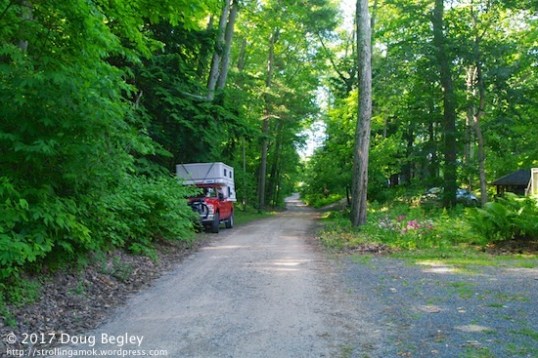
The roads near the shoreline are simply hard-pack sand, one lane wide. Yes, everything really is this green.

US-31 itself is down to 55 MPH and has stoplights in towns, but this is not abused, and breezing through is still pleasant. Once you hit your desired crossroad toward shore, a dirt turnoff is presented and it’s sand from there on in. Sand, sometimes rocky or with a hint of dirt, is all there is. It’s packed to a pavement-like firmness. The shore in “my ” area rises in Read more…

Buh-Bye Pano

The other day I e-biked to the very nice sightseeing viewpoint vista on Mingus Mountain, then further up to a cliff that also has a magnificent view of Cottonwood below. Officially, this was a trash disposal run and, not having slung my Pentax over my shoulder, I pressed my old iPhone 4s into service to take a shot. I’d never used the “PANO” setting, which allows you to press the shutter and sweep the camera horizontally to take in a wide panoramic shot. I’d never bothered, because on the few occasions where I wanted a wide shot, I’d simply take a series of exposures with the Pentax and then let Photoshop Elements stitch them all together. Trim off the edges to suit, and the result is a long ribbon of vista.

Once back in the camper with my bunny slippers on, I transferred the snaps to my laptop and took a look. Uh-oh.
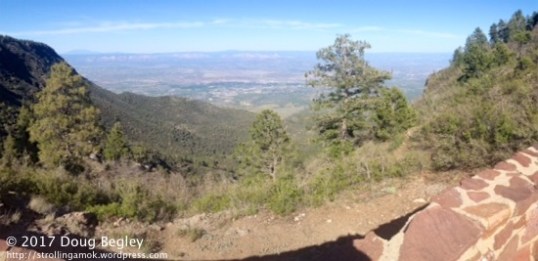
From the Viewpoint.

This isn’t a panorama so much as a fisheye lens view. The sweep distance between the two trees is actually quite a span, and the image is much narrower than I expected for its height, being close to a widescreen movie format. No likee. It would be a fab way to shoot confined spaces like the camper interior, but outdoors, it reduces a broad, eye-filling valley to resemble a ravine.

At the cliff area, which looked like an exciting way to kill yourself if you were a stumbler, the result was much the same.
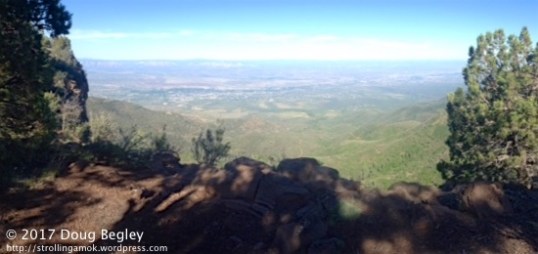
This was actually pretty close to a 90-degree sweep!

Bizarre. It looks so narrow! Why isn’t this 3 times wider than it is? However, I took a normal backup shot just in case something stunk about Plan A.
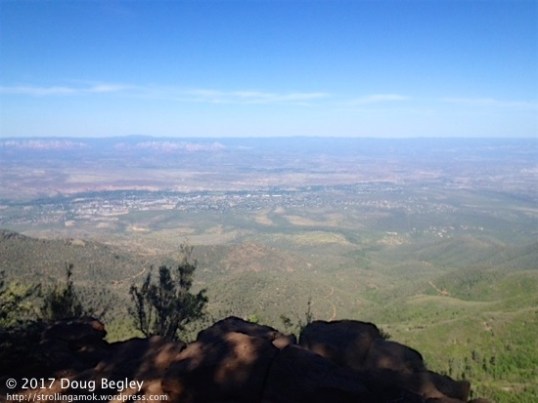
Reality. Or closer, anyway. Your eyes can pick up gradations of light & dark that the lens can’t, can cut through some haze, and read out details missing in the shot.

By the way, both of the shots above were taken from the same vantage point (I didn’t move an inch). The vertical smashing is what makes me think of a fisheye or wide-angle lens. A real pano doesn’t do that, and doesn’t smash in the width, either. It’s a little more like OmniTheater 360, but not wrapping around quite so far. A few of these, strung across, stitched edge to edge and corrected for distortion, give a very different result.

And here it is:

No, wait, here it isn’t. My ancient copy of Photoshop Elements that allowed automatically stitching together images, is on my big iMac back at Rancho Begley. But even it doesn’t work any more, the victim of a recent operating system upgrade. I don’t use panorama shots enough to make an update worthwhile, particularly not for $85, since I dropped all other interest in Elements once Aperture came along. For serious photography, Aperture is like a handmade hunting knife as opposed to Elements being more like a Leatherman utility tool. Aperture does just one thing, but does it intuitively and excellently, with a minimum of effort. Elements is a Jack of all trades if you’re willing to fight out the processes needed and not injure yourself with it. It’s like an affordable version of Photoshop, which is the icon of Feature Bloat.

Unfortunately for me, Apple discontinued Aperture some time ago, saying that its new Photos program was just as good, and was built in as an app for iPhones and iPads, too! I tried it, and it would not do, not at all. If something happens to the original photo or drive such that Photo can no longer locate it, it’s gone even when a backup or copy is lurking about somewhere. There’s a blank image there that can’t be fixed or filled. Aperture signals a problem and at least gives you a chance to locate and hook back up to the duplicate as a matter of course. It is built with the assumption that, given enough time, hard drives are going to crap out and the computer’s working environment is going to change in some way. Aperture is also designed for use on a desktop computer, and takes advantage of the extra screen real estate to make tunneling down through menus and sub-menus unnecessary. The options are still available on a laptop, but the size of the image being displayed suffers for it. In contrast, Photo seems to be designed for use on an iPhone across the board, cleaned up and Spartan to the point of not indicating what if any tasks can be done to adjust or edit photos. When you have to be told what the trick is to something, that means it’s not intuitive. Its barebones appearance on the screen is pretty much a waste on a 27″ UltraHD monitor, since it follows the iPhone mantra of hiding everything it can. Lots of Clean Screen.

Using Photo for a couple of hours made me so exasperated that I began to research some magical way of getting Aperture to work again on my updated operating system. Fortunately for me, I found it. it seems that before consigning Aperture to the trash heap, Apple made one last update to it that allowed it to keep working under the most recent “family” of OS versions. All I needed was that Aperture update. But the App Store, the program that controls what should and can be updated, was not seeing Aperture on my iMac, perhaps because I’d bought it on CD when I purchased my desktop in 2009. I contacted the App Store online, who promptly shuffled me off to Applecare Professional Support in order to get some kinda mystery code I could feed into the App Store to let it know I legitimately had Aperture and needed to download the latest update of it. The manager of Pro Support talked me through it, it worked like a charm, and Aperture started working again on my desktop. Joy!

Just before the call ended, I was asked why I preferred hoary old Aperture to the new whiz-bang Photo, and I managed to keep it down to the main two issues: what’s clean and easy on an iPhone is not the necessarily the best interface to use on a big monitor, where hiding everything away is a Bad Thing, and that when reality strikes, Photo will only ever show grey holes, where Aperture can be steered to recover what’s gone missing. That’s Professional. Off the record, Photo is for dabblers who, if they lose photos, often say, “Oh well, I wonder what they were. I’ll make more.” When photographs are an income source, losing them or making their replacement arduous costs time and therefore money. Losing the edits previously made to the original does the same.

To my surprise, the next time I yanked out my laptop, Aperture was also waiting to be installed on it, even though it had never been on it. So, I’m a happy camper. Thank you, Apple, even though you’re trading away serious usability for trendy features and appearances. You kept me able to use your “obsolete” program.

I might not again update my operating system, in order to ensure that Aperture keeps rolling. See, sooner or later, there will be a new series of OS updates that once again make programs incompatible with them. I was able to get along okay on my original operating system just fine until last year, when certain other programs really benefited from an update that could only run on a newer OS. Maybe I’ll be able to retain Aperture for a good long while further. Besides, the latest version of the operating system I’m using now has scores and scores of wonderful-I’m-sure new features and abilities that I’ll never have any use for. Between hackers and government misuse, I can’t bring myself to use The Cloud and, even if I could, don’t have even a fraction of the cellular data rental needed to use it anyway. I’ll bet using Siri to open programs and stuff is nice, but every question and command uses Internet data. I do what I do, and that’s not complex. I don’t need to “Express yourself in fun new ways. Send a huge emoji. Respond back with a heart or a thumbs-up on a friend’s message bubble. And play videos and preview links right in the conversation.” Getting my work done more quickly or simply impresses me a great deal. Using the PANO option on the iPhone is admittedly a heap easier and faster than stitching together separate photos in a third-party program, but as with many things that say they make things faster and easier, there’s a trade-off: Control over the qualities of what you get.

Risk Management Rebooted

Here’s something to consider. I found the two videos below to be supremely interesting despite their titles. That’s because “Survival Planning” is a fooler for us Norte Amerikahnskis. The interviewee, Mac Mackenney, is not a survivalist in the hopeless gloom-and-doom apocalyptic zombie warfare sense that we gravitate toward. He is a genuine adventurer who makes it his business to manage risk in inordinately risky conditions. In that way, I found his approach, his simple way of recognizing risks, sorting through them, prioritizing them, and addressing them as helpful in an everyday sense for anyone who boondocks. Technically, anyone who hits the Interstate for a decent trip might benefit as well. There are three parts to this set from Andrew White, but I have included only the two most pertinent. Each is 25-30 minutes long, so if you have limited cellular data or an overactive bladder, this might be an issue. If you could hardly care less about simple ways of looking at risk and survival, but do enjoy rather impressive campfire stories, these are also for you.

I present these to you principally because first, they helped me recognize how what I choose to do and how I go about it affects my safety, and how simple changes can decrease exposure to risk. Second, because it is easy to go on assumptions and fail to recognize the inherent risks within our choices, it is easy (at least in the Great Southwest) to wind up in what are potentially very serious situations, without realizing it. I keep stumbling over accounts of everyday people caught by surprise and unprepared for what is around them. Sometimes they get aided or rescued, and sometimes they do not. The videos below are not a “how to” so much as a wake up call to recognize potential risks in your rig setup choices as well as how you camp, and prioritize them so that the most effective  and influential solutions come first. None of this is miracle-level brilliance – it simply clears away the chaff and helps you recognize your most important needs first. If you can only see one, the meat of it is in Part 2.

Part 2:

The Americanization of Overlanding

Like a modern-day Norman Rockwell painting, this photo has every possible “Adventuring” cliche packed in. Photo Source: Expedition Portal

Travel has always been popular, but ever since the 1920s and 1930s, world travel picked up as the thing to do, if you had the funds. Hollywood glamorized it as a way that sophisticated people could take in other interesting cultures in exotic locales. Whether by ship, by train or even by aircraft in the later years, travel and stories of travel and adventure held a fascination for people unable or unwilling to take on the very considerable challenges that world travel could sometimes impose. Modified cars and trucks tended to be used only for well-funded “expeditions”.

World travel tends to be very different today, because the world is very different. One has to look hard for areas that have not been heavily Westernized such that such that the original dress, diet and culture that were once so alluring have been largely erased. With business, political, and military interests driving colonialism and the forced installation of accommodating governments, conditional foreign aid payments or covert operations where direct force would appear a little too obvious, a sense of moral and even racial superiority, plus tourism itself, where the clientele expect Western accommodations, diet and conveniences after they’ve viewed what they came to see, and individual corporations striving to change the local culture enough to accommodate them – these have all taken their toll over the years. In the end, many of the culturally-based things that people go to see are now recreations maintained just for the sake of the local tourism industry. Once authentic, they are now museum performances. Any authentic vestiges of the culture are often only viewable by making the effort to get away from the areas of even moderate development.

World travel today isn’t so much “travel” as “arrival”. Whatever romance or inconveniences the slower mode of travel included, those are gone.

World travel in the twentieth century has always been principally based on mass transportation. It still is today. You use it to get to a destination directly, then depart it, explore, and experience. What is today called overlanding is a branch of world travel that dispenses with mass transportation and substitutes getting yourself across the landscape to Point B by way of a personal vehicle. Classical overlanding is planned vehicle-based travel, typically including border crossing(s), making or providing one’s own shelter, and carrying enough food, water and fuel to be able to reach various supply points along the planned route. This not being a jaunt from motel and restaurant to motel and restaurant, self-reliance is required for both Read more…

Post Navigation